Running a marketing campaign without a clear strategy can waste advertising budgets, reduce engagement, and disappoint sales.
For small and medium-sized businesses (SMEs) in Malaysia, every marketing decision matters, especially when budgets and resources are limited.
This is where the 5W1H marketing framework becomes useful.
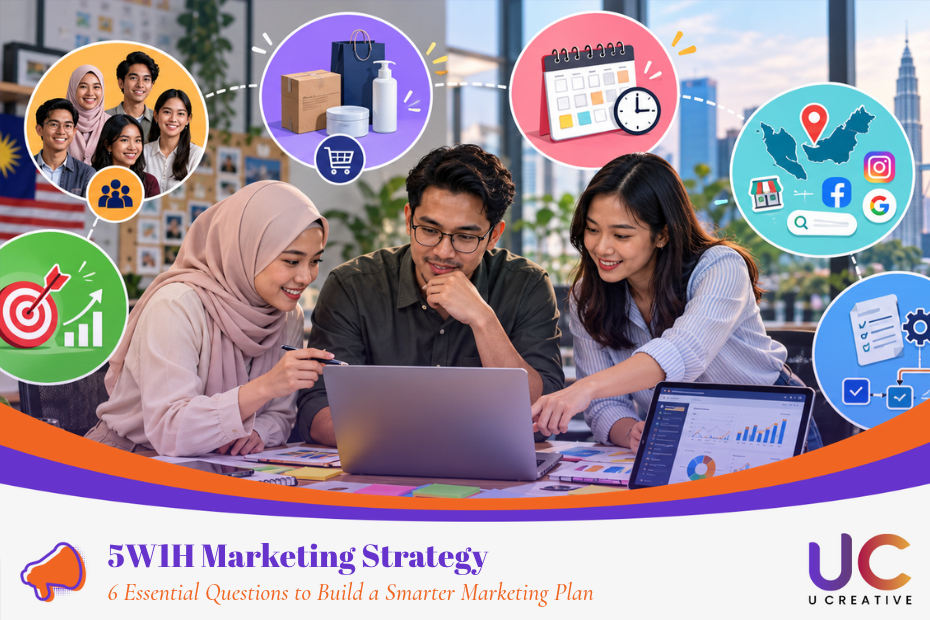
By answering six simple questions — Who, What, When, Where, Why, and How — businesses can build a more structured marketing strategy, understand their customers, and make better decisions.
In this guide, we’ll explain how 5W1H marketing works, with practical examples that Malaysian businesses can apply to their digital marketing campaigns.
What Is 5W1H in Marketing?
5W1H is a planning framework built around six essential questions: Who, What, When, Where, Why, and How.
Originally used in journalism and problem-solving, the framework also applies widely to business planning and marketing.
In marketing, 5W1H helps businesses identify their customers, define their products or services, choose suitable marketing channels, and plan how to achieve their goals.
Here is a simple breakdown:
| 5W1H | Marketing Question | Purpose |
|---|---|---|
Who |
Who are your target customers? |
Identify your audience |
What |
What are you promoting? |
Define your product and value |
When |
When should you promote it? |
Choose the right timing |
Where |
Where can you reach customers? |
Select marketing channels |
Why |
Why are you running the campaign? |
Establish clear objectives |
How |
How will you execute the campaign? |
Plan your actions and budget |
Instead of jumping straight into Facebook Ads or Google Ads, businesses can use these six questions to create a clearer, more focused marketing plan.
How to Apply 5W1H to Your Marketing Strategy?
1. Who: Identify Your Target Audience

Before promoting a product or service, understand who is most likely to buy it.
Trying to target everyone often means reaching people with little interest in your offering.
Start by identifying your ideal customers based on factors such as:
- Age group and location
- Interests and purchasing behavior
- Budget and spending habits
- Problems they want to solve
- Preferred social media or online platforms
Example in Malaysia:
A wedding gift supplier in Penang might target engaged couples planning their weddings, wedding planners, and companies looking for customized event gifts. By understanding these audiences, the business can create more relevant advertisements and landing pages.
💡SEO Tip: Research keywords that your target customers actually search for, such as “custom wedding gifts Malaysia” or “corporate gifts supplier Penang”. These keywords often indicate clearer purchasing intent than broad terms such as “gifts”.
2. What: Define Your Product and Unique Selling Point
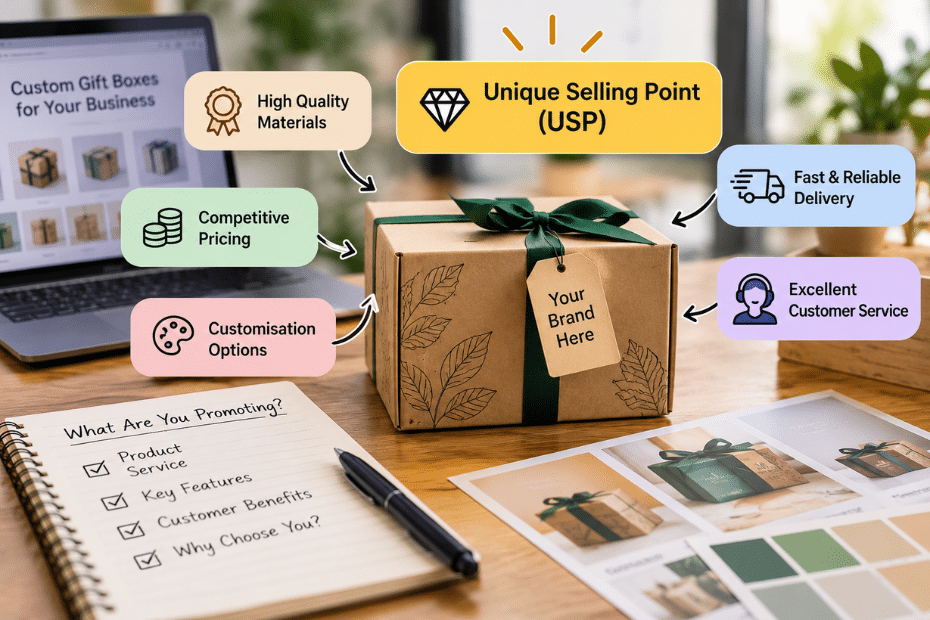
The next question is simple: What makes your product or service worth choosing?
Customers care about more than what you sell. They also want to know how it benefits them and why they should choose your business over competitors.
Identify your unique selling proposition (USP) by considering product quality, pricing, convenience, customization, customer service, or other meaningful differences.
Example in Malaysia:
Instead of advertising: “We sell corporate gift boxes.”
A business could communicate: “Custom corporate gift boxes in Malaysia, with personalized packaging and bulk order options.”
The second message gives potential customers a clearer understanding of the service and who it’s for.
💡SEO Tip: Highlight your USP in your website’s page titles, product descriptions, and meta descriptions where relevant. Focus on natural, helpful wording rather than repeating keywords.
3. When: Choose the Right Marketing Timing
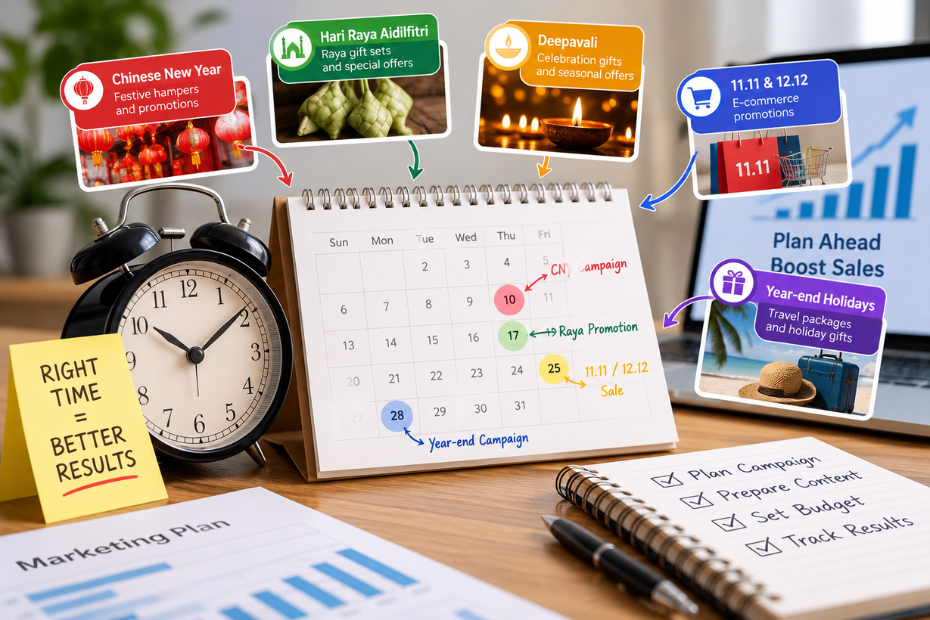
Timing can influence a marketing campaign’s success.
In Malaysia, consumer spending and shopping behavior may change during festive seasons, major shopping events, and school holidays.
Businesses should consider when their customers are most likely to research or purchase products.
Some common marketing opportunities include:
| Ocassion | Marketing Opportunity |
|---|---|
Chinese New Year |
Festive Hampers and Corporate Gifts |
Hari Raya Aidilfitri |
Raya Gift Sets and Festive Promotions |
Deepavali |
Celebration Gifts and Seasonal Offers |
11.11 and 12.12 |
E-Commerce Promotions |
Year-End Holidays |
Travel Packages and Holiday Gifts |
For example, a festive hamper business should prepare product pages and organic SEO content well before the festive period, allowing time for discovery and indexing.
You can then schedule paid campaigns based on order deadlines, stock availability, and expected customer demand.
💡SEO Tip: Use Google Trends and historical Google Search Console performance to identify seasonal search patterns before planning your content calendar.
4. Where: Select the Right Marketing Channels

Not every digital marketing platform suits every business.
Your marketing channels should depend on where your target audience searches, compares products, and makes purchasing decisions.
For Malaysian businesses, common digital marketing channels include:
| Marketing Channel | Best For |
|---|---|
Google Search & SEO |
Customers actively searching for products or services |
Google Ads |
Reaching customers through relevant paid searches |
Facebook & Instagram |
Brand discovery, engagement, and product promotion |
TikTok |
Short-form video content and product discovery |
Shopee & Lazada |
Marketplace-based product sales |
WhatsApp Business |
Handling inquiries and following up with customers |
For example, a plumbing service in Kuala Lumpur may benefit from local SEO and Google Ads targeting searches such as “emergency plumber KL”.
Meanwhile, a fashion retailer may use Instagram and TikTok to showcase new collections and attract customers through visual content.
💡SEO Tip: For location-based businesses, optimize your Google Business Profile and create useful, location-specific service pages to improve your visibility in relevant local searches.
5. Why: Set Clear Marketing Objectives
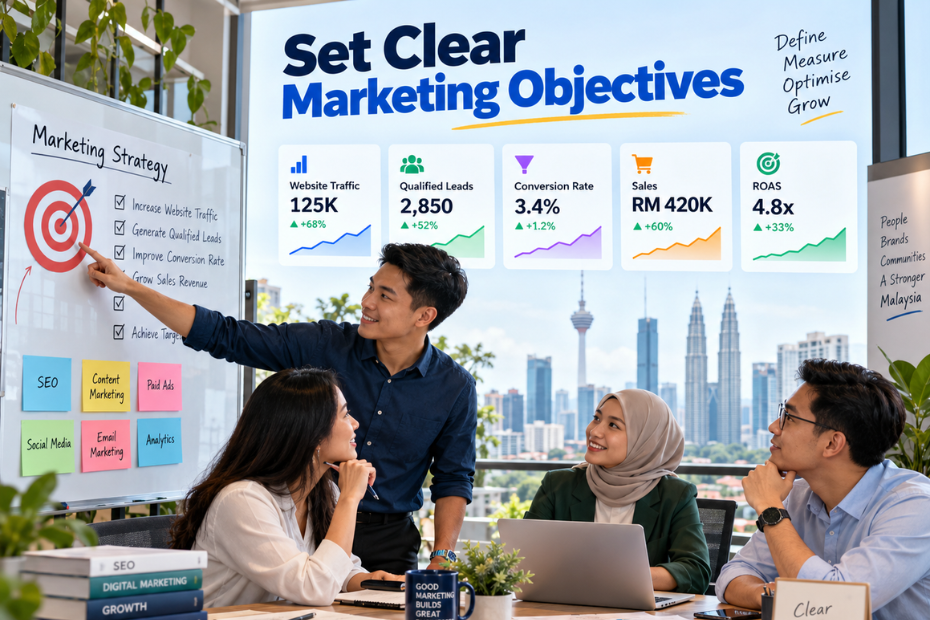
Every marketing campaign should have a measurable purpose.
Without clear objectives, it becomes difficult to determine whether your marketing activities are delivering meaningful results.
Common marketing objectives include increasing website traffic, generating qualified inquiries, improving brand awareness, and boosting product sales.
Instead of setting a vague goal such as “get more customers”, establish something measurable.
For example:
“Generate 50 qualified WhatsApp inquiries within 30 days from a Google Ads campaign.”
You can then track key performance indicators (KPIs) such as:
- Website organic traffic
- Leads and inquiries
- Conversion rate
- Cost per lead (CPL)
- Return on ad spend (ROAS)
The most suitable metrics depend on your business model and campaign objectives.
6. How: Plan and Execute Your Marketing Campaign

Once you’ve answered the first five questions, the final step is turning your strategy into action.
This includes deciding how much to spend, what content to create, which platforms to use, and how to measure performance.
Example: A Malaysian SME with an RM3,000 monthly marketing budget
| Marketing Activity | Example Budget |
|---|---|
Google Ads |
RM1,200 |
Facebook & Instagram Ads |
RM800 |
SEO Content Creation |
RM600 |
Creative Content & Design |
RM400 |
Total |
RM3,000 |
The budget above is an illustrative planning example, not a recommended allocation for every business.
A company should adjust its budget based on its objectives, competition, available resources, and actual campaign performance.
Businesses can also use tools such as Google Analytics 4 (GA4), Google Search Console, and advertising platform dashboards to monitor results.
The key is to review performance regularly and improve campaigns based on data, not assumptions.
Practical 5W1H Marketing Example in Malaysia
Let’s look at how a local café in Penang could apply the 5W1H framework to promote a new weekend brunch menu.
| 5W1H | Example Marketing Strategy |
|---|---|
Who |
Young working adults, local food lovers, and tourists visiting Penang |
What |
A new weekend brunch menu with specialty coffee |
When |
Launch promotions two weeks before the new menu becomes available |
Where |
Instagram, TikTok, Google Business Profile, and the café website |
Why |
Increase weekend reservations and attract new customers |
How |
Publish short-form videos, improve local search visibility, and run targeted social media ads |
For its website SEO strategy, the café could target relevant search terms such as “weekend brunch Penang”, “best brunch café George Town”, and “café with brunch menu Penang”.
However, targeting these keywords alone is not enough. The business should also provide accurate menu information, opening hours, location details, photos, and a clear reservation or contact option.
This example demonstrates how 5W1H connects customer targeting, digital marketing channels, and business objectives into one practical strategy.
How to Improve Your 5W1H Marketing Strategy?
Creating a marketing plan is only the beginning. Businesses should also review results and improve over time.
Here are three practical approaches.
1. Monitor Your Marketing KPIs
Track metrics that are directly related to your campaign objectives. For example, an e-commerce business may prioritize sales and conversion rates, while a service provider may focus on qualified inquiries.
2. Analyze Customer Behavior
Use tools such as GA4 and Google Search Console to understand how customers discover and interact with your website.
Identify which pages attract relevant traffic, which search queries bring visitors, and where users may leave without converting.
3. Test and Refine Your Campaigns
Experiment with different advertising messages, creative materials, landing pages, and targeting approaches.
Change one major variable at a time where possible, so you can better understand what influences campaign performance.
By regularly reviewing your 5W1H marketing strategy, you can make more informed decisions and allocate your marketing budget more effectively.
Common 5W1H Marketing Mistakes to Avoid
Although the framework is simple, businesses can still make mistakes when applying it.
| Common Mistake | Better Approach |
|---|---|
Targeting everyone |
Define a specific customer segment |
Promoting features without benefits |
Explain the value customers receive |
Running campaigns at the wrong time |
Plan around purchasing behavior and seasonality |
Using too many marketing channels |
Prioritize channels with relevant audiences |
Focusing only on views and likes |
Measure business-related outcomes |
Launching without tracking |
Establish KPIs before starting |
Remember that 5W1H is a planning framework, not a guarantee of marketing success.
Results also depend on factors such as product demand, competition, pricing, execution quality, and customer experience.
Build a Smarter Marketing Strategy With 5W1H
A successful marketing campaign doesn’t always require a large advertising budget. It requires clear objectives, a strong understanding of your customers, and a structured execution approach.
The 5W1H marketing framework gives Malaysian businesses a practical starting point for planning marketing campaigns, whether they invest in SEO, Google Ads, social media, or other digital marketing channels.
By answering Who, What, When, Where, Why, and How, businesses can reduce guesswork, prioritize marketing activities, and use their resources more effectively.
Ultimately, the goal is not simply to reach more people, but to reach the right customers with the right message at the right time.
Frequently Asked Questions
5W1H stands for Who, What, When, Where, Why, and How. These six questions help businesses plan marketing campaigns by identifying their target audience, defining their offer, selecting appropriate channels, and establishing measurable objectives.
Yes. The 5W1H framework is particularly useful for Malaysian SMEs because it provides a simple way to organise marketing activities without requiring expensive software or complicated planning methods.
The 5W1H framework focuses on six planning questions, while the 4Ps focus on Product, Price, Place, and Promotion. Both frameworks can work together to help businesses develop a more complete marketing strategy.
Yes. Businesses can apply 5W1H to SEO, Google Ads, social media marketing, email campaigns, and e-commerce promotions. It helps clarify the purpose, audience, timing, and execution of each activity.
5W1H can support SEO planning by helping businesses understand their audience’s search intent, identify useful content topics, select relevant keywords, and create pages that address customer needs. However, SEO performance also depends on content quality, technical accessibility, competition, and other factors.
Ready to Build a Smarter Marketing Strategy?
Turn your 5W1H marketing plan into action with tailored digital marketing solutions that help your Malaysian business reach the right audience and generate quality leads.
Get a Free Consultation