Imagine spending thousands of ringgit on a professional website, running Google Ads, and posting regularly on social media, only to receive very few inquiries or sales.
Sound familiar?
For many Malaysian SMEs, the problem isn’t necessarily their advertising budget or website design. It’s that their website isn’t built around how their target customers decide to buy.
A B2B manufacturer in Penang and a B2C fashion retailer in Kuala Lumpur may both need a website, but their customers expect completely different experiences.
According to the Department of Statistics Malaysia (DOSM), 74.4% of Malaysian business establishments had an online presence in 2024, while 58.7% operated their own websites.
As more businesses compete online, a website alone is no longer enough. Understanding the differences between B2B and B2C marketing is essential to turning website visitors into paying customers.
What Is the Difference Between B2B and B2C?
B2B (Business-to-Business) refers to companies selling products or services to other businesses, while B2C (Business-to-Consumer) focuses on selling directly to individual customers.
Here are some familiar examples from Malaysia:
B2B Example: Manufacturing Supplier

A Penang-based precision engineering company supplies components to factories and multinational corporations. Its customers prioritise technical specifications, production capacity, certifications, and reliable delivery.
B2C Example: Online Gift Shop
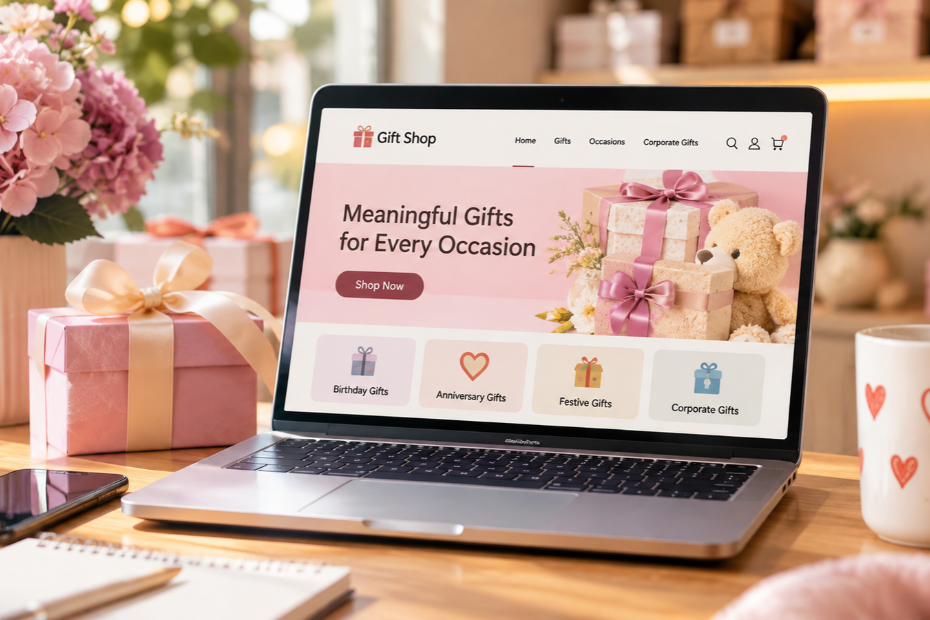
A Malaysian gift shop sells birthday hampers, festive gifts, and personalised presents. Customers are more likely to compare prices, product designs, delivery options, and reviews before purchasing.
B2B vs B2C: Key Differences Malaysian Businesses Should Know
| Factor | B2B | B2C |
|---|---|---|
Target Audience |
Companies and Organisations |
Individual Consumers |
Buying Decision |
Often involves multiple descsion-maker |
Usually Individual or Family |
Sales Cycle |
Typically Longer |
Often Shorter |
Key Motivation |
Reliability, ROI, Expertise |
Price, Convenience, Emotion |
Website Goal |
Generate Qualified Leads |
Drive Purchases |
Common CTA |
Request a Quote |
Buy Now |
Here’s what many business owners overlook: A website that attracts more visitors doesn’t automatically generate more revenue.
For B2B companies, five qualified corporate inquiries can be more valuable than attracting thousands of visitors with no purchasing intent.
Meanwhile, B2C retailers often depend on a smooth checkout experience and consistent customer traffic to generate sales.
The right website strategy should focus on business outcomes, not traffic numbers alone.
4 Website Design Strategies for B2B and B2C Businesses in Malaysia
1. Understand What Your Customers Are Looking For
Before designing a website, consider why someone would visit it.
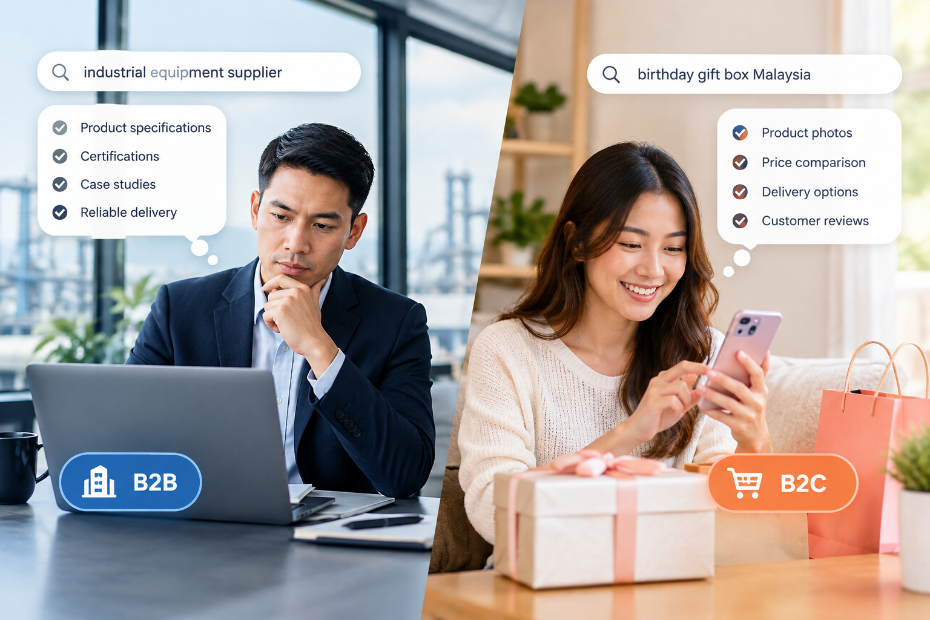
For B2B buyers, the first question is often: “Can this company meet our business requirements?”
They want product specifications, certifications, case studies, and evidence of reliability.
B2C shoppers are more likely to ask: “Is this product worth buying?”
They want attractive photos, transparent pricing, genuine reviews, and convenient delivery.
💡Website tip: For B2B websites, highlight your expertise and business capabilities. For B2C websites, make product discovery and purchasing as straightforward as possible.
2. Build Trust Through the Right Website Content

Trust matters in both models, but customers evaluate it differently.
A Malaysian B2B supplier can strengthen credibility by displaying industry certifications, completed projects, customer testimonials, and detailed company information.
For a B2C brand, customer reviews, real product images, return policies, and secure payment options can be more persuasive.
In my view, many Malaysian SME websites focus too heavily on looking professional while overlooking what actually makes customers trust them.
An impressive homepage means little if visitors cannot find essential information about your products or services.
3. Use Different SEO Strategies for B2B and B2C
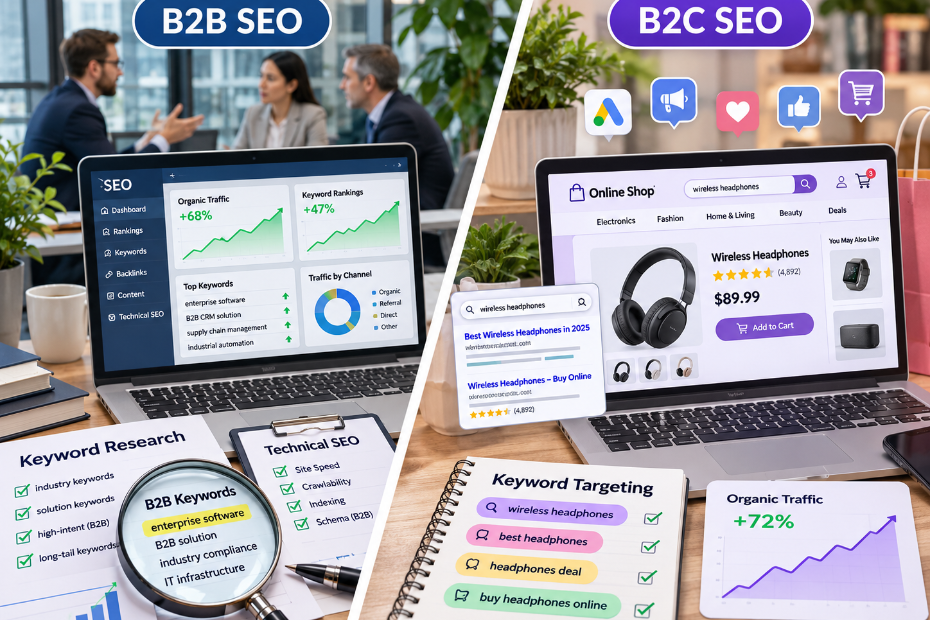
Search engine optimization (SEO) is important for both business models, but keyword intent should guide your content strategy.
For example:
| B2B SEO Keywords | B2C SEO Keywords |
|---|---|
Precision engineering company in Malaysia |
Birthday gift delivery Malaysia |
Industrial equipment supplier Penang |
Personalized gifts KL |
Corporate gift supplier Malaysia |
Affordable gift box Malaysia |
Website development company Malaysia |
Buy skincare online Malaysia |
B2B SEO should prioritize industry-specific service pages, detailed product information, and educational content that addresses business problems.
B2C SEO should focus more on product categories, purchase-intent keywords, product descriptions, and seasonal search trends.
For Malaysian businesses, incorporating relevant location-based keywords such as “Penang”, “Kuala Lumpur”, or “Johor Bahru” can also help reach geographically relevant customers.
However, avoid adding locations or keywords unnaturally. Google prioritizes helpful content that satisfies search intent rather than keyword repetition.
4. Optimize Your Website for Conversions, Not Just Traffic
Imagine a potential customer visits your website and likes what they see, but cannot find your contact details or checkout button.
That’s a missed business opportunity.
For Malaysian B2B companies, effective conversion features may include enquiry forms, downloadable catalogues, WhatsApp Business integration, and clear “Request a Quote” buttons.
For B2C websites, prioritise mobile-friendly product pages, simple checkout flows, delivery information, and payment options familiar to Malaysian customers, such as FPX and DuitNow where supported.
Both website types should load quickly, work smoothly on mobile devices, and provide clear navigation.
📝Remember: Good website design doesn’t simply make your business look better. It reduces the effort customers need to take the next step.
What If Your Malaysian Business Serves Both B2B and B2C Customers?
Many Malaysian businesses operate in both markets.
Consider a corporate gift supplier that also sells birthday presents and festive hampers to individual customers.
Should it build two separate websites?
Not necessarily.
For smaller businesses, maintaining separate websites can increase development costs, SEO workload, and ongoing maintenance.
A practical solution is to create two clearly defined customer journeys within one website. This approach allows businesses to serve different customer needs while maintaining a consistent brand identity.
Separate websites may still make sense when the two markets have substantially different branding, product catalogs, or operational requirements.
Final Thoughts: Build a Website That Fits Your Business Model
Whether you run a B2B manufacturing company, a B2C online store, or a business serving both markets, your website should reflect how your customers search, evaluate, and purchase.
Malaysian businesses often invest heavily in advertising to generate more traffic. Yet improving website navigation, content clarity, and conversion pathways can be just as important.
Before increasing your marketing budget, ask yourself one question:
“Does my website make it easy for the right customers to do business with me?”
If the answer is no, improving your website strategy could be a more valuable starting point than launching another advertising campaign.
Frequently Asked Questions (FAQ)
B2B marketing targets businesses and usually emphasizes expertise, long-term relationships, and return on investment. B2C marketing targets individual consumers and often focuses on convenience, pricing, and emotional appeal.
SEO benefits both. B2B businesses can use it to attract qualified inquiries, while B2C businesses can use it to increase product visibility and organic sales.
Yes. A single website can support both audiences through separate landing pages, product categories, and conversion paths. Separate websites are not always necessary.
It depends on business requirements. WordPress suits content-driven corporate websites, while WooCommerce and Shopify are common e-commerce options. Custom development may be appropriate for more complex workflows and integrations.
Ready to Turn Your Website Into a Business Growth Tool?
With the right web design, SEO strategy, and user experience, it can help attract relevant customers and convert more visits into valuable business opportunities.