Finding SEO content ideas is not difficult. Search for almost any keyword, open a keyword research tool, and you can generate hundreds of possible topics within minutes.
The difficult part is identifying which ideas are actually worth producing.
A strong SEO content idea should attract the right audience, address a real search need, support your business objectives, and provide readers with something more useful than what already exists.
This means content planning should not begin with: “What should we publish this week?”
It should begin with: “What information is our target audience actively looking for, and what can we contribute that deserves to be found?”
Google states that its ranking systems are designed to prioritize helpful, reliable content created primarily for people rather than content produced mainly to manipulate rankings.
This guide explains what makes a good SEO content idea, where to find new topic opportunities, and how to turn search, customer, and performance data into an actionable SEO content strategy.
What Makes a Good SEO Content Idea?
A keyword with search volume is not automatically a good content idea. The best SEO topics sit at the intersection of five factors:
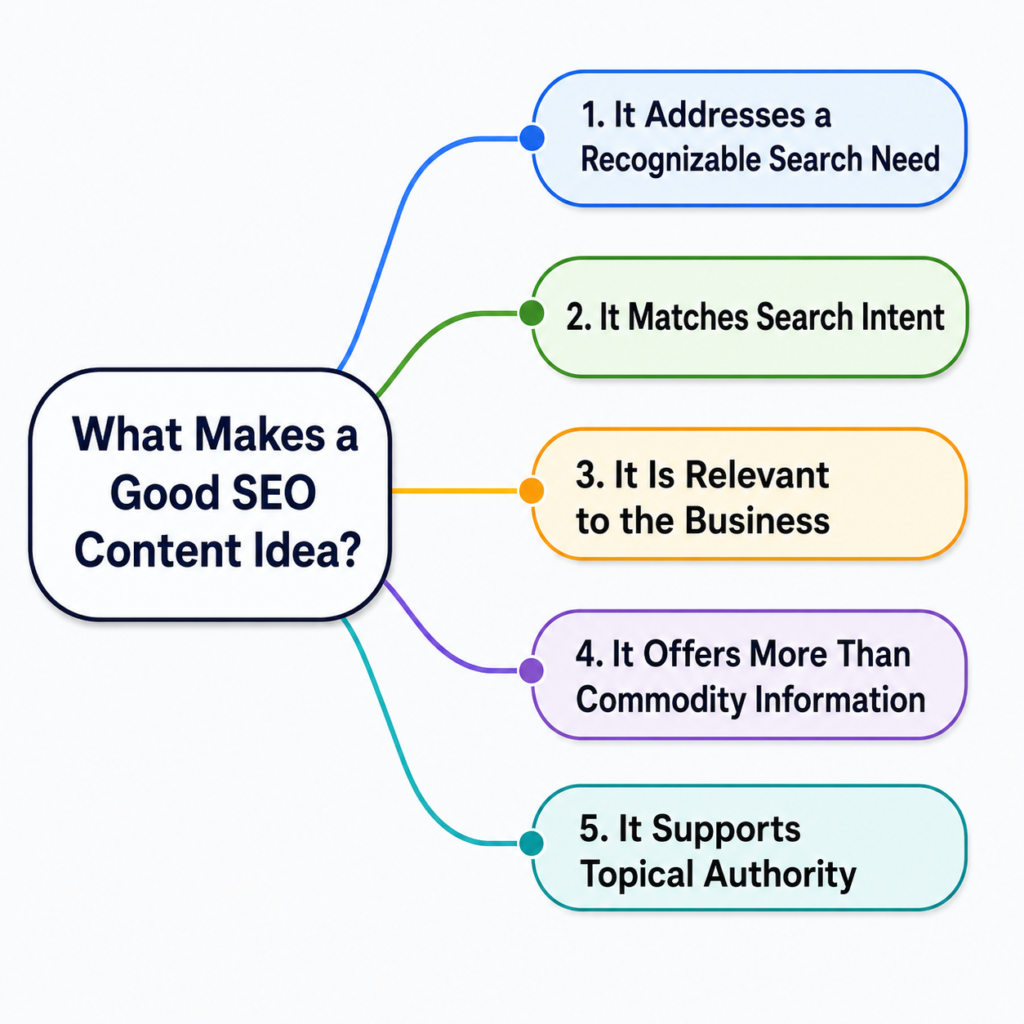
1. It Addresses a Recognizable Search Need
Every effective SEO topic should connect to a problem, question, decision or task that people are already searching for.
For example, “digital marketing” is a broad subject, but it does not reveal exactly what the searcher needs.
More specific topics might include:
- How much does digital marketing cost in Malaysia?
- SEO or Google Ads: which is better for a new business?
- How long does SEO take to generate leads?
- Why is my website receiving traffic but no inquiries?
- What should a monthly SEO report include?
Each topic represents a clearer need and gives the writer a more defined objective.
Before approving an idea, ask:
- What is the searcher trying to achieve?
- What problem triggered the search?
- What information would help the searcher take the next step?
- Is the searcher learning, comparing, evaluating, or preparing to buy?
The clearer the need, the easier it becomes to produce focused content.
2. It Matches Search Intent
Search intent describes the reason behind a query. Most content ideas fall into four broad categories:
- Informational Intent: The user wants to understand something.
- Commercial Investigation: The user is comparing options before making a decision.
- Transactional Intent: The user is ready to take an action.
- Navigational Intent: The user is trying to reach a particular company, tool, or page.
A content idea becomes stronger when its format matches its intent. A “how-to” query may require a tutorial, while a “best” or “versus” query usually requires a comparison.
Do not force every keyword into a standard blog article. The correct result may be a service page, a landing page, a glossary, a calculator, a checklist, a case study, or a product category page.
3. It Is Relevant to the Business
High traffic does not always produce business value.
A web design company may rank for “free website color palettes,” but that audience may be less commercially valuable than people searching for:
- Website redesign cost
- Why a business website is not generating leads
- Landing page design for Google Ads
- E-commerce website features
- Website maintenance packages
A good SEO content idea should create a logical path between the searcher’s current problem and the company’s solution.
That does not mean every article should aggressively promote a service. It means the subject should be sufficiently relevant for the business to have a legitimate reason to discuss it.
4. It Offers More Than Commodity Information
Repeating the same definitions found across dozens of competing pages rarely creates a compelling reason to rank.
Google’s current guidance for visibility in both conventional and AI-powered search recommends producing unique, expert-led, non-commodity content that provides value beyond common knowledge.
For example, instead of publishing another general article titled “What Is SEO?”, an agency could produce:
- What Malaysian SMEs Usually Get Wrong About SEO
- How We Diagnose a Website That Gets Traffic but No Leads
- What Six Months of Search Console Data Reveals About Buyer Intent
- SEO Cost in Malaysia: What Actually Affects the Quotation?
These ideas are more specific, experience-based, and difficult for competitors to reproduce accurately.
5. It Supports Topical Authority
Strong SEO strategies do not consist of unrelated articles selected only because each keyword has search volume.
Content should help a website build depth on subjects central to its expertise.
Each page should cover a distinct need while linking naturally to related resources.
Google recommends using crawlable links and descriptive anchor text because links help it discover pages and understand their relevance.
How to Find New SEO Content Ideas
The best content ideas usually come from combining several research sources rather than relying on a single keyword tool.
1. Google Search Console
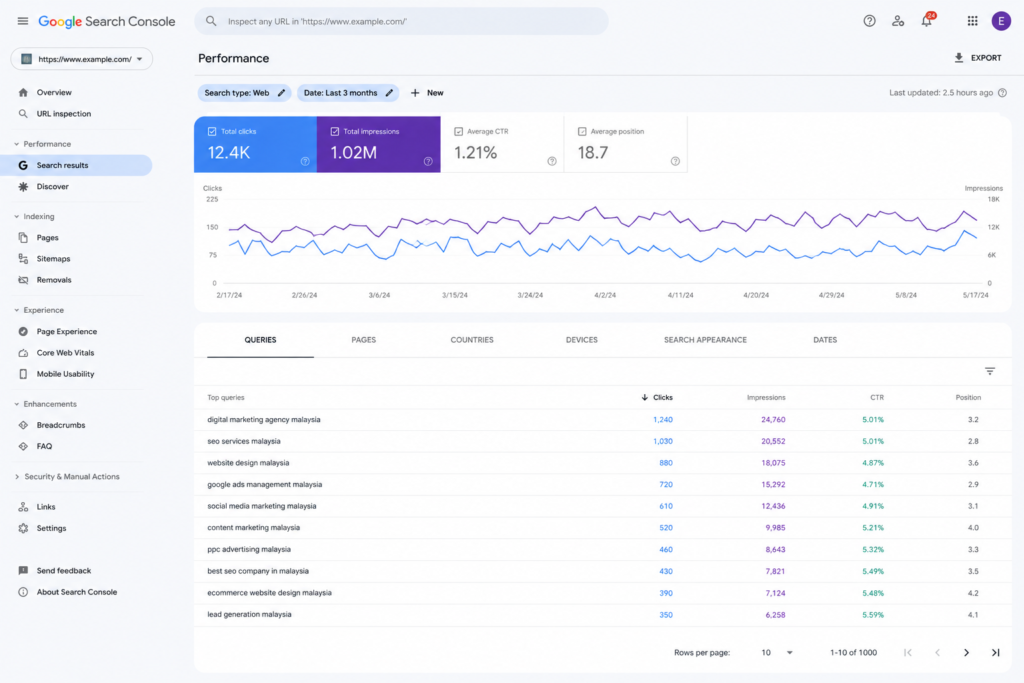
Google Search Console should be one of the first places to look, as it shows how your website is already appearing in Google Search.
The Performance report includes queries, pages, clicks, impressions, click-through rate, and average position. It can reveal the searches that already generate visibility for your website.
Instead of adding all these phrases randomly to the existing article, you could create a dedicated guide about website design pricing and connect it to the main service page.
Search Console data is especially useful because it reflects your website’s real search visibility rather than relying entirely on third-party estimates.
2. Google Trends
Google Trends helps you assess whether interest in a subject is growing, declining, seasonal or concentrated in particular locations.
Google explains that Trends uses an anonymized, categorized and aggregated sample of actual Google search requests.
Use it to:
- Compare different terms
- Identify seasonal demand
- Find rising topics
- Explore regional interest
- Compare local terminology
- Discover related searches
The Related Searches section can reveal top and rising queries connected to a topic. This helps determine which terminology is more familiar to the intended market.
However, Trends shows relative interest rather than exact search volume. Use it for direction and comparison, not as the only source for estimating traffic potential.
3. Google Keyword Planner
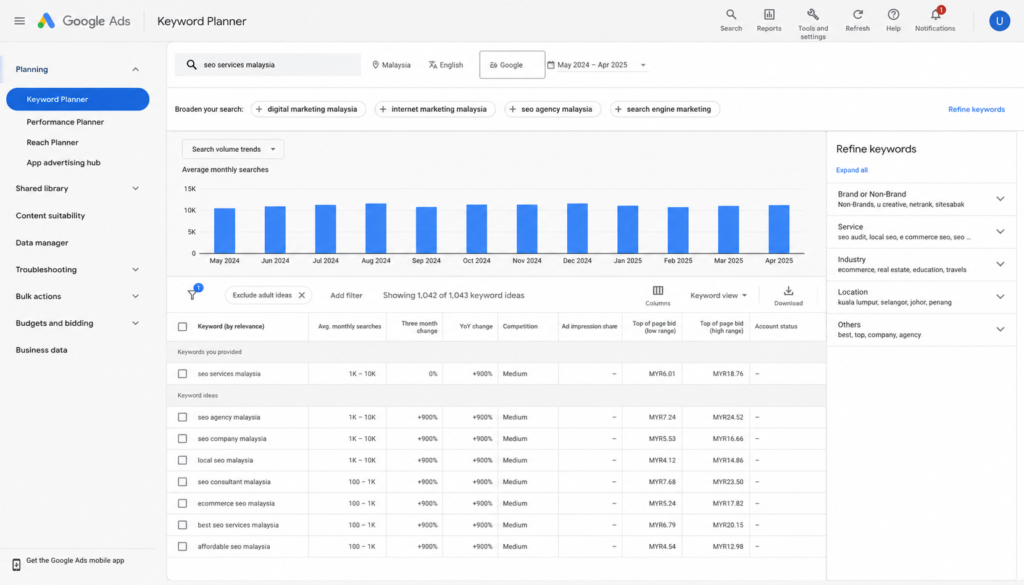
Google Keyword Planner can generate related keyword suggestions and provide estimated monthly search information.
Do not simply export every suggestion.
For example, “SEO services” might lead to topic groups covering SEO pricing, local SEO, e-commerce SEO, SEO packages, SEO audits, and comparisons between SEO and paid advertising.
4. Google Search Results
Google’s search results can reveal how Google interprets a query and what users may expect from the answer.
More importantly, review the type of pages ranking.
Are they tutorials, listicles, service pages, category pages, videos or tools?
If nearly every high-ranking result is a product category, publishing an informational blog article may not satisfy the dominant intent.
Search results also help identify weaknesses in existing content. Look for questions competitors answer poorly, outdated examples, missing local context, and claims lacking evidence.
5. Sales and Customer-Service Conversations
Customer-facing teams are valuable sources of high-intent content ideas.
Review recurring questions from:
- Sales calls
- WhatsApp enquiries
- Email conversations
- Live chat
- Customer-support tickets
- Quotation requests
- Product reviews
- Client onboarding meetings
- Project objections
Pay close attention to questions asked immediately before a purchase.
Examples include:
- How long will the project take?
- What is included in the package?
- Why is this option more expensive?
- Can I start without a website?
- How do I compare two service providers?
- What happens after I sign the agreement?
These questions may have modest search volume, but they often represent strong commercial intent.
6. Internal Site Search
When visitors use the search bar on your website, they tell you what they expected to find.
Analyze internal search data for:
- Topics with no suitable results
- Product names
- Service-related questions
- Pricing searches
- Location searches
- Misspellings and alternative terminology
A repeated internal search may indicate that important information is difficult to find or missing entirely.
7. Competitor Content Gaps
Competitor research should identify market gaps, not encourage imitation.
Do not create an article simply because a competitor has one.
Ask whether you can produce something more accurate, practical, specific or useful.
8. Communities and Social Platforms
Industry communities reveal how people describe their problems in natural language.
These platforms, such as Reddit discussions, Quora questions, Facebook groups, and so on, are useful for identifying pain points, objections, and emerging terminology.
The final topic should still be validated against search intent, business relevance, and available data before being added to the content calendar.
9. Paid Search Data
Google Ads search-term data can reveal commercially valuable phrases that triggered advertisements.
Google’s search terms report helps advertisers see the searches that matched their keywords and generated ad activity.
Paid data is valuable because conversions can help distinguish commercially useful topics from keywords that merely generate traffic.
Conclusion
The best SEO content ideas do not come from keyword volume alone.
They come from understanding what people are searching for, why they are searching, how the topic connects to the business, and what unique value the company can contribute.
Use keyword tools to identify demand. Use Search Console to find real opportunities. Use customer conversations to uncover commercial intent. Use internal data and professional experience to create information competitors cannot easily reproduce.
Most importantly, treat content ideation as a continuous system rather than a one-time brainstorming exercise.
When search data, customer insight, business priorities and original expertise work together, content stops being something published merely to fill a calendar.
It becomes a long-term asset that improves visibility, builds trust and moves potential customers closer to a decision.