Sometimes, the existing website still has a good structure, useful content and working functionality. It simply needs a better design and user experience. In other cases, the problems go deeper and may require a more complete website redesign and development approach.
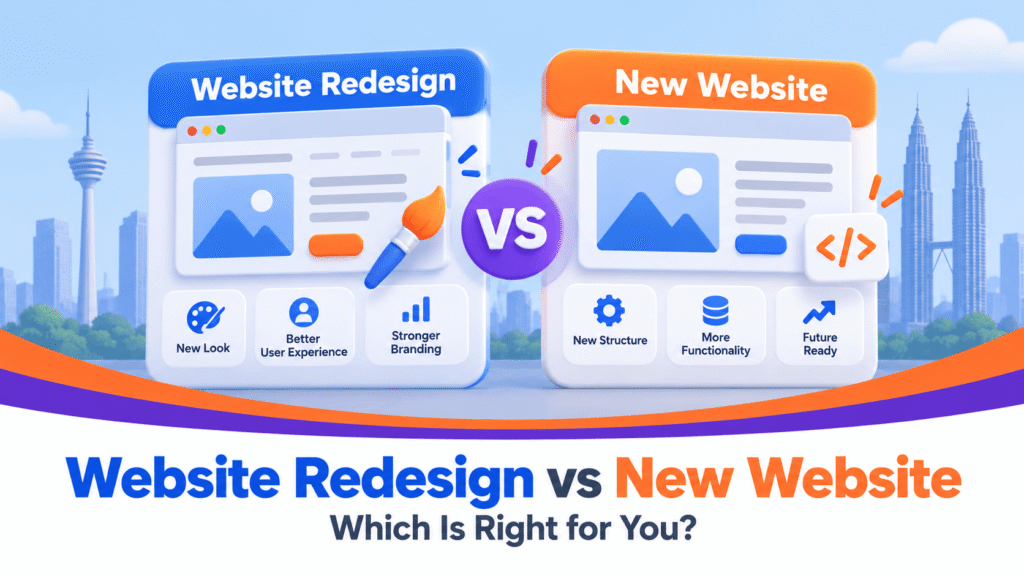
So how do you decide between a website redesign and a new website?The answer depends less on how old your website is and more on what is actually limiting it.Website Redesign vs New Website: What Is the Difference?
The terms are sometimes used interchangeably, but they do not always mean the same thing.
A website redesign improves an existing website while retaining parts of its current foundation. Depending on the project, this could include updating the visual design, navigation, page layouts, content presentation, mobile experience and conversion paths.
A new website involves rebuilding more of the underlying structure. This may include a new CMS or technology stack, new site architecture, new page templates, new functionality and a different approach to how content is organised.
The line between the two is not always clear. A major redesign can eventually become a rebuild if too many parts of the existing website need to be replaced.
A better question is therefore not simply:
“Is my website old?”
It is:
“How much of my current website is still worth keeping?”
When Does a Website Redesign Make More Sense?
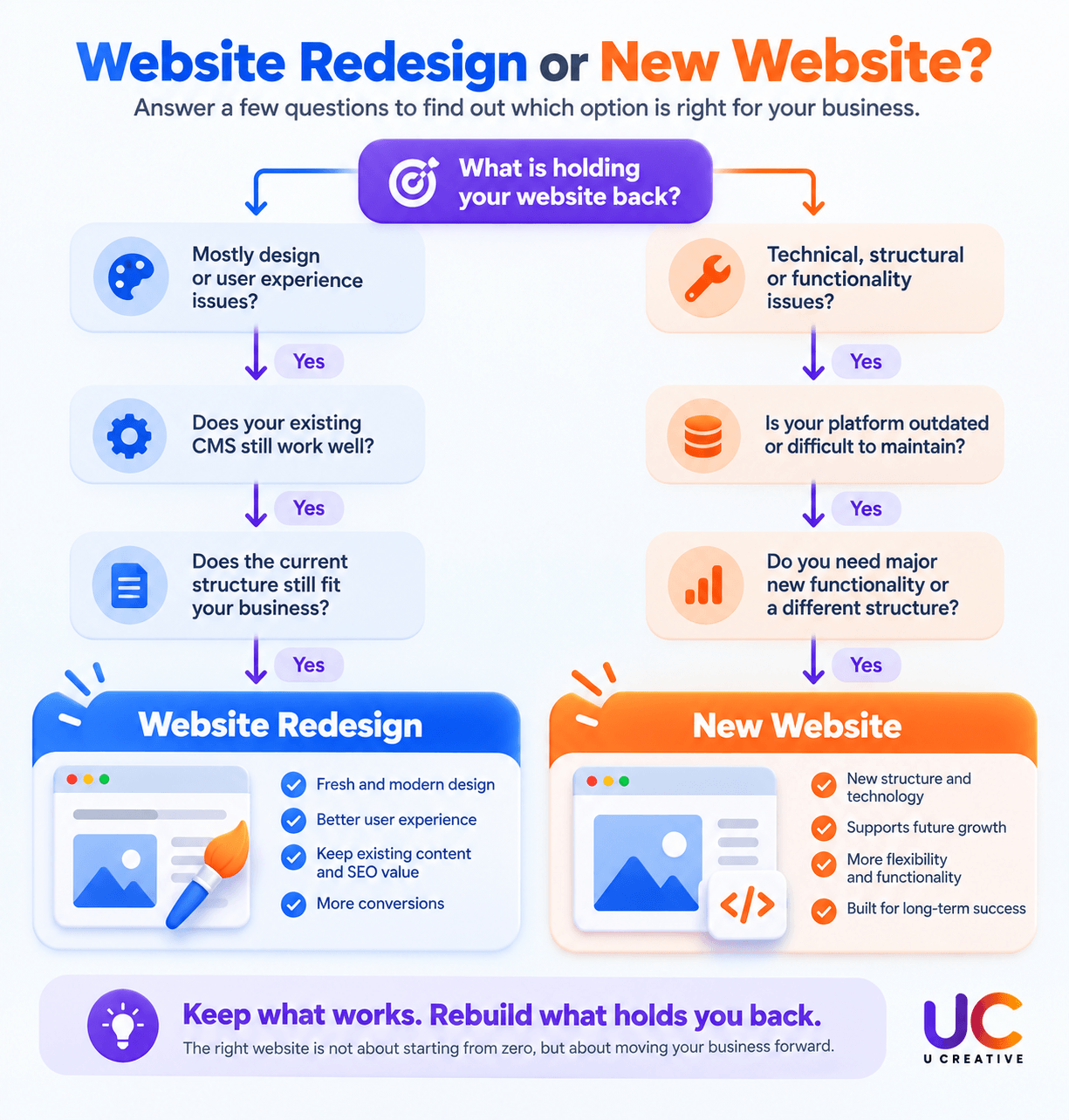
A redesign can be the more practical option when the foundation of your website still works.
For example, your website may already have useful pages, a manageable CMS and URLs that perform in search, but the design no longer represents your business well.
1. Your Website Looks Outdated
A dated appearance does not automatically mean the entire website needs to be rebuilt.
If the underlying system still works well, you may only need to update elements such as typography, colours, imagery, layouts and page hierarchy.
The goal should not simply be to make the website look newer. A redesign should make important information easier to find and help visitors understand what your business offers.
2. The User Experience Needs Improvement
Visitors may be reaching your website but struggling to navigate it.
Common problems include confusing menus, important information buried too deep, unclear calls to action or layouts that do not work well on smaller screens.
If these issues can be solved without replacing the underlying system, redesigning the existing website may be enough.
3. Your Branding Has Changed
Businesses evolve.
You may have changed your positioning, visual identity, services or target market while your website still reflects an older version of the company.
If the current structure can support the new direction, a redesign can bring the website back in line with the brand without requiring a complete rebuild.
4. Your Existing Content and SEO Structure Are Valuable
An established website may already have pages receiving organic traffic, backlinks and search visibility.
That does not mean you should never change those pages. It means the existing search performance should be considered before making major structural changes.
Where possible, valuable URLs and content can be retained while the design and user experience are improved.
When Is It Better to Build a New Website?
A redesign becomes less practical when the problems are not limited to appearance or usability.
If you are repeatedly working around technical limitations, a new website may provide a cleaner foundation.
1. Your Current Technology Is Holding You Back
Older platforms, unsupported software, outdated plugins or heavily customised systems can make even simple website changes difficult.
You may find that adding a new feature breaks something else, security updates become increasingly difficult, or nobody on your current team fully understands how the website was built.
At that point, continuing to patch the old system can create more complexity.
A new build gives the business an opportunity to choose a platform and structure that better fit its current requirements.
2. Your Website Structure No Longer Matches Your Business
A company may begin with a few services and later expand into multiple divisions, locations or customer segments.
If the original website was not designed for that growth, navigation and content can gradually become difficult to organise.
Adding more pages to a weak structure does not necessarily solve the problem.
A new website allows you to reconsider the information architecture from the beginning and create clearer relationships between services, products, locations and supporting content.
3. You Need Functionality the Current Website Cannot Support
Your original website may have been built primarily to provide company information.
Later, you may need features such as:
- E-commerce
- Membership or customer portals
- Booking systems
- API integrations
- Multilingual content
- Advanced forms or lead-generation workflows
- Integration with internal business systems
Some features can be added to an existing website. Others may require so many workarounds that rebuilding becomes more practical.
The decision should be based on technical feasibility, long-term maintainability and business requirements rather than adding features simply because they are available.
4. Performance Problems Are Built Into the Existing Site
A slow website does not automatically require a rebuild.
Large images, unnecessary scripts, poor caching and other individual problems can often be optimised.
However, performance problems can also be tied to the underlying theme, codebase, plugins or architecture. If repeated optimisation only produces limited improvement, rebuilding on a cleaner foundation may be worth considering.
5. The Website Is Difficult to Maintain
Your team should not need a developer every time someone wants to update a paragraph, replace an image or publish a new article.
If routine updates are unnecessarily difficult, the website may no longer suit the way your business operates.
A new build can provide a more manageable content system and reduce dependence on technical support for everyday changes.
Website Redesign or New Website: A Simple Comparison
| Your Situation | Redesign May Be Enough | Consider a New Website |
|---|---|---|
| Design looks outdated | ✓ | |
| Branding has changed | ✓ | |
| Navigation needs improvement | ✓ | |
| Existing CMS works well | ✓ | |
| Existing pages already perform well in search | ✓ | |
| Platform is outdated or unsupported | ✓ | |
| Website is difficult to maintain | ✓ | |
| Structure no longer fits the business | ✓ | |
| Major new functionality is required | ✓ | |
| Technical limitations affect future development | ✓ |
This should be treated as a starting point rather than a strict rule.
A website can have issues on both sides of the table. The right approach depends on the condition of the existing site and how much work would be required to make it suitable for the next few years.
What About SEO When Redesigning or Rebuilding a Website?
SEO should be considered before development begins, not after the new website goes live.
This becomes especially important if a redesign or rebuild changes URLs, navigation, content or site structure.
Google recommends creating a mapping between old and new URLs when URLs change and using permanent server-side redirects, such as 301 or 308 redirects, to send users and search engines to the appropriate new pages.
Internal links, canonical tags and XML sitemaps should also be updated to reflect the new URLs. Removing useful content or redirecting many unrelated old pages to the homepage can also create problems.
For businesses that already receive organic traffic, it is useful to review Google Search Console and analytics data before development starts. This helps identify important pages, rankings and search traffic that should be considered during the migration.
This is also where SEO and website development should work together. At UCreative, our SEO services consider website structure, existing search visibility and on-page elements during a redesign or rebuild, helping businesses reduce avoidable SEO issues during the transition.
After launch, rankings and traffic should continue to be monitored. Significant website changes can cause temporary fluctuations while Google crawls and processes the updated pages.
Do You Need to Change Your Domain Too?
Usually, redesigning or rebuilding a website does not require changing the domain name.
If your existing domain still represents the business, keeping it can make the migration simpler.
Changing the domain, URLs, CMS, content and design at the same time introduces more variables into the project. Google recommends making major site changes one at a time where practical, particularly during a site move.
If a domain change is necessary because of a rebrand, merger or other business reason, it should be treated as a planned website migration rather than a simple design update.
Avoid Rebuilding Just for the Sake of Starting Fresh
A completely new website can sound attractive because it removes the limitations of the old one.
But starting fresh also creates work.
Existing content needs to be reviewed and migrated. URLs may need to be mapped. Analytics and tracking need to be checked. Forms and integrations must be tested. Search performance needs to be monitored after launch.
If the current website has a strong foundation, replacing everything may create unnecessary cost and migration risk.
The opposite is also true.
If the website has fundamental structural or technical problems, repeatedly redesigning individual pages can become an expensive way of postponing a rebuild.
The objective is not to preserve as much as possible or replace as much as possible.
It is to keep what still provides value and rebuild what is holding the website back.
Planning Your Next Website Project
Before deciding between a redesign and a new website, review what is working, what is not and what your business will need in the future.
Consider your website structure, performance, content, SEO, functionality and how easy it is to manage. If the existing foundation is still strong, a redesign may be enough. If technical or structural limitations are holding the website back, rebuilding may be the better approach.
If you are unsure where to start, our website design and development team in Penang can assess your current website and recommend a practical way forward.
Frequently Asked Questions (FAQs)
How often should a website be redesigned?
There is no fixed schedule for redesigning a website. Instead of redesigning based on age alone, consider whether the website still supports your branding, user experience, SEO, functionality and business goals.
Is it cheaper to redesign a website or build a new one?
A redesign may cost less when the existing website has a solid structure and technology that can be retained. However, if extensive technical changes are required, rebuilding the website may be more practical than repeatedly fixing an outdated system.
Can I redesign my website without losing SEO rankings?
A redesign does not automatically cause ranking loss, but changes to URLs, content, internal links and site structure can affect SEO. Important pages should be reviewed before development, and URL changes should be properly redirected and monitored after launch.
Can I keep my existing domain when building a new website?
Yes. You can build a completely new website while keeping your existing domain. A domain change is usually only necessary when there is a separate business reason, such as a rebrand or company name change.
How do I know whether my website needs a redesign or a rebuild?
Start by identifying whether the main problems are visual or structural. If the platform and website structure still work well, a redesign may be enough. If outdated technology, poor architecture or technical limitations are restricting the business, a rebuild may be more suitable.