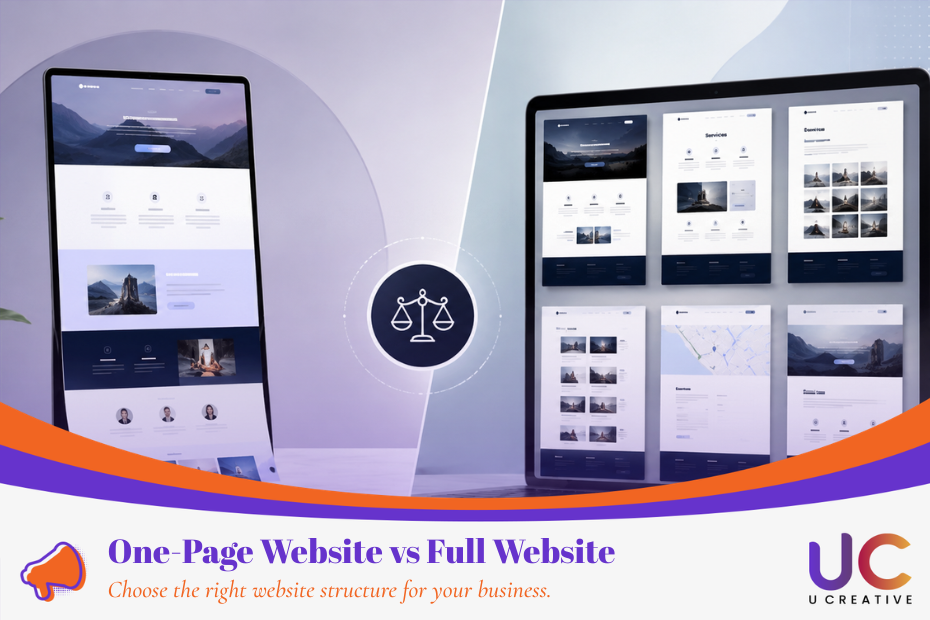
A one-page website puts most of a business’s key information on a single page, allowing visitors to scroll through the content and take a clear action.
This structure can work well for businesses with one main service, product, audience or conversion goal. It is also commonly used for advertising campaigns, events, product launches and start-ups.
A full website, in this article, refers to a traditional multi-page website, where services, company information, case studies and other content are organised across separate pages.
Neither option is automatically better. The right choice depends on what your customers need to know, how many services you offer, how important organic search is to your business and how much you expect the website to grow.
One-Page vs Multi-Page Website: At a Glance
| Factor | One-Page Website | Multi-Page Website |
|---|---|---|
| Main Goal | Focused conversion | Long-term growth and information |
| Best For | One main offer or simple business | Multiple services, products or audiences |
| SEO | Best for a focused topic | Better for multiple search intents |
| User Journey | Simple and linear | More flexible and navigational |
| Content | Concise | More detailed and scalable |
| Expansion | More limited | Easier to expand |
| B2B Use | Suitable for simple offers | Better for complex buying decisions |
| Future Growth | Can become restrictive | Easier to add services and content |
The key difference is not simply the number of pages. It is how much information your business needs to present and how many different topics you want the website to cover.
What Is a One-Page Website?
A one-page website places most of the main information about a business on a single URL.
Instead of sending visitors to separate About, Services, Portfolio and Contact pages, the website uses sections within one page.
A typical structure might look like:
Hero → About → Services → Benefits → Testimonials → FAQ → Contact
This works particularly well when visitors only need to understand one main offer before taking one action, such as requesting a quotation, booking a consultation or making an enquiry.
For example, a consultant offering one core service may not need a large website if all the information customers need can be presented clearly on one page.
Is a One-Page Website the Same as a Landing Page?
Not necessarily.
A one-page website may serve as the entire website for a small business, freelancer or focused service.
A landing page is usually created for a specific campaign, audience or conversion goal.
For example, a company may have a full multi-page corporate website but still create a dedicated landing page for Google Ads, a product launch, an event or a specific promotion.
So businesses do not necessarily have to choose between a full website and landing pages. A multi-page website can provide the main online presence, while landing pages can support specific marketing campaigns.
When Should You Use a One-Page Website?
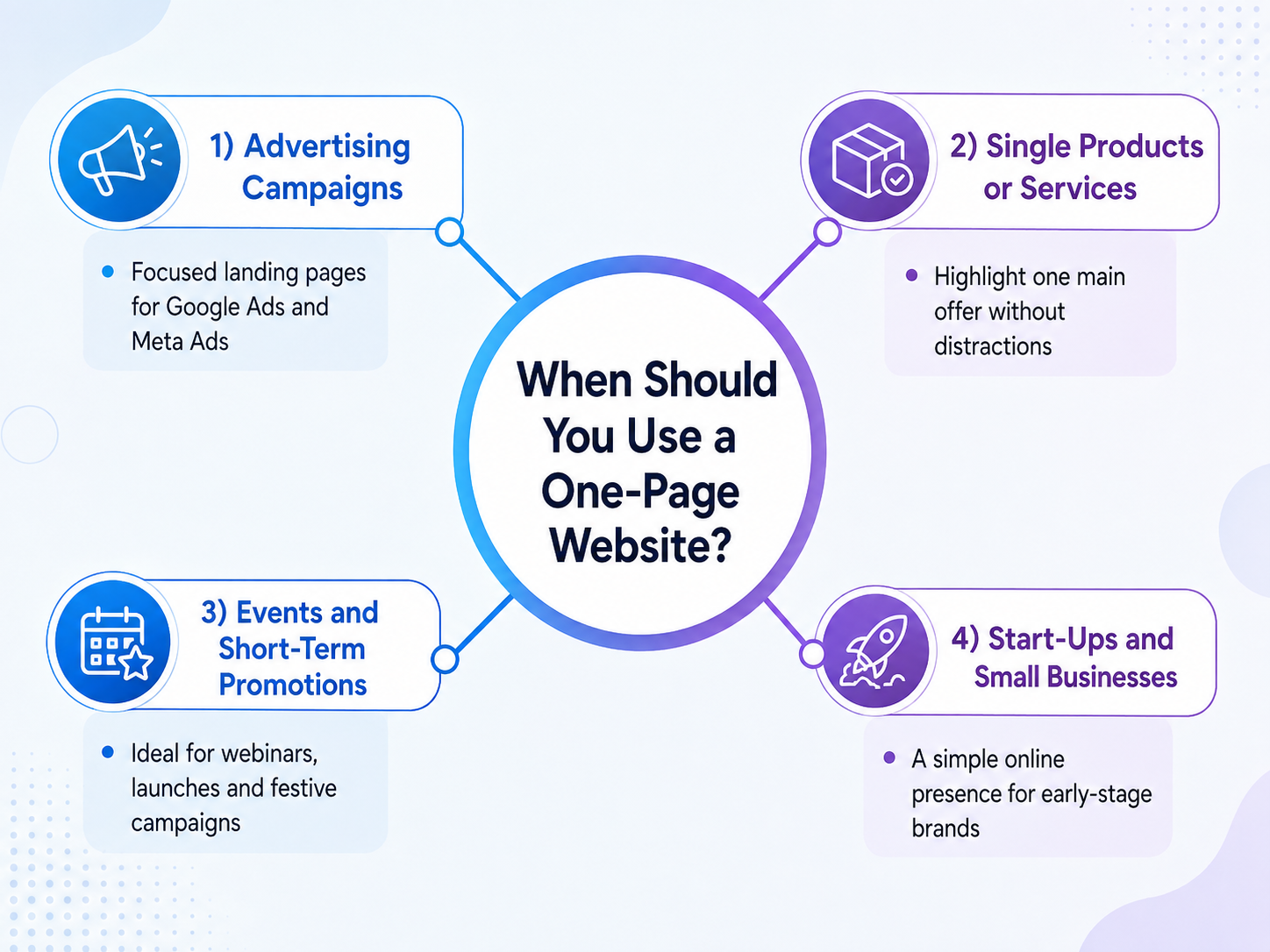
A one-page website is most suitable when the business has a focused message and a relatively simple customer journey.
1. Advertising Campaigns
For Google Ads or Meta Ads campaigns, a focused page can remove unnecessary distractions and guide visitors towards one clear action.
A strong advertising page may include:
- Service or product benefits
- Supporting evidence
- Testimonials
- FAQs
- A clear call to action
The conversion goal may be to:
- Request a quotation
- Submit an enquiry
- Contact via WhatsApp
- Book a consultation
2. One Main Product or Service
If your business is promoting one main product or service, a one-page structure can create a simple customer journey:
Problem → Solution → Benefits → Proof → CTA
This can be effective for consultants, freelancers, specialised services, product launches and specific service packages.
3. Events and Short-Term Promotions
Webinars, seminars, festive campaigns and limited-time promotions often do not require a large website.
Visitors usually need only the key information before registering, purchasing or contacting the organiser.
4. Start-Ups and Small Businesses
A one-page website can provide a professional online presence without requiring a large amount of content at the beginning.
However, it is worth considering future plans before choosing this structure. If you expect to add several services, locations, case studies or content later, a multi-page website may be easier to manage as the business grows.
When Is a Multi-Page Website Better?
A multi-page website is more useful when customers need to explore different offers or review detailed information.
Multiple Services or Products
If customers may search for or compare different services separately, giving each important service its own page makes the website easier to understand.
For example, a web development company may offer:
- Corporate website design
- E-commerce website development
- Landing page design
- Website redesign
Putting all of these services on one page can make the content crowded and difficult to organise.
Separate service pages allow each offer to explain its benefits, process, pricing approach, FAQs and relevant examples in more detail.
Different Customer Needs
A business may also serve different audiences with different questions.
For example, a B2B customer may want to review services, case studies, technical capabilities, industry experience, certifications and company background before making an enquiry.
A multi-page website makes it easier for visitors to find the information relevant to their decision without forcing everything onto one long page.
Businesses Planning to Grow
A website that starts with three services may eventually need pages for new services, locations, case studies, resources or different customer segments.
A multi-page structure gives you more room to organise that growth.
This does not mean a business should create dozens of pages from the beginning. The structure should grow according to genuine customer and business needs.
Which Is Better for SEO?
A one-page website can rank on Google. Having only one page does not automatically make a website bad for SEO.
The main limitation is scalability.
When a business wants to target several different services or search intents, one URL has to represent all of those topics. This can make the content less focused.
A multi-page website allows each important service or topic to have its own URL, content and keyword focus. It also gives the business more opportunities to build useful supporting content and internal links around different topics.
However, having more pages does not automatically mean better SEO.
Every page still needs a clear purpose and useful content. Creating thin or repetitive pages simply to target more keywords can make a website harder to manage without providing much value to users.
If organic search is an important long-term growth channel and your business has several services, a multi-page structure will usually provide more SEO flexibility.
Which Is Better for User Experience?
Both structures can provide a good user experience when they are designed around the visitor’s needs.
A one-page website can create a smooth and simple journey when users only need a small amount of information before taking action.
However, as more content is added, excessive scrolling can make specific information harder to find.
A multi-page website is usually easier to navigate when visitors have different needs.
For example, a potential B2B customer may want to review a company’s services, case studies, certifications, technical capabilities and background before making an enquiry.
Separating this information into logical pages can make the website easier to explore without overcrowding one page.
What Are the Limitations of a One-Page Website?
- Limited SEO scalability: One URL has to cover most topics, making it harder to target several different search intents.
- Longer pages: Adding more services and information can make the page harder to navigate.
- Less content depth: Complex products or B2B services may need more information than one page can present clearly.
- Limited room to grow: New services, locations and resources may eventually require a multi-page structure.
These limitations do not make one-page websites a poor choice. They simply mean the format works best when the website has a focused purpose and relatively simple content needs.
5 Questions to Help You Decide
If you are still unsure which website structure is suitable, ask these five questions.
1. Do you offer more than one product or service?
If your business focuses on one main product or service, a one-page website may be enough.
If you offer several services that customers may search for or compare separately, a multi-page website usually makes the information easier to organise.
2. Do you want to rank for different search topics?
If organic search is an important part of your growth strategy, consider how many different topics or services you want your website to appear for.
A one-page website can work well for one focused topic. A multi-page website provides more flexibility when different services need their own content and search visibility.
3. Do customers need detailed information before contacting you?
Some customers only need a clear offer, a few reasons to trust the business and a way to make contact.
Others, especially B2B or high-value customers, may want to review services, case studies, company experience and other details before making an enquiry.
The more information customers need, the more useful a multi-page structure can become.
4. Will your website need to grow?
Think beyond what your website needs today.
Will you eventually add new services, locations, articles, case studies or languages?
If the answer is yes, a multi-page website usually gives you more room to expand without overcrowding one page.
5. Is your main goal one campaign or one action?
If the main purpose is to promote one offer and encourage visitors to take one action, such as requesting a quotation, registering for an event or contacting you through WhatsApp, a one-page website can work very well.
If visitors need different paths depending on what they are looking for, a multi-page structure may be more suitable.
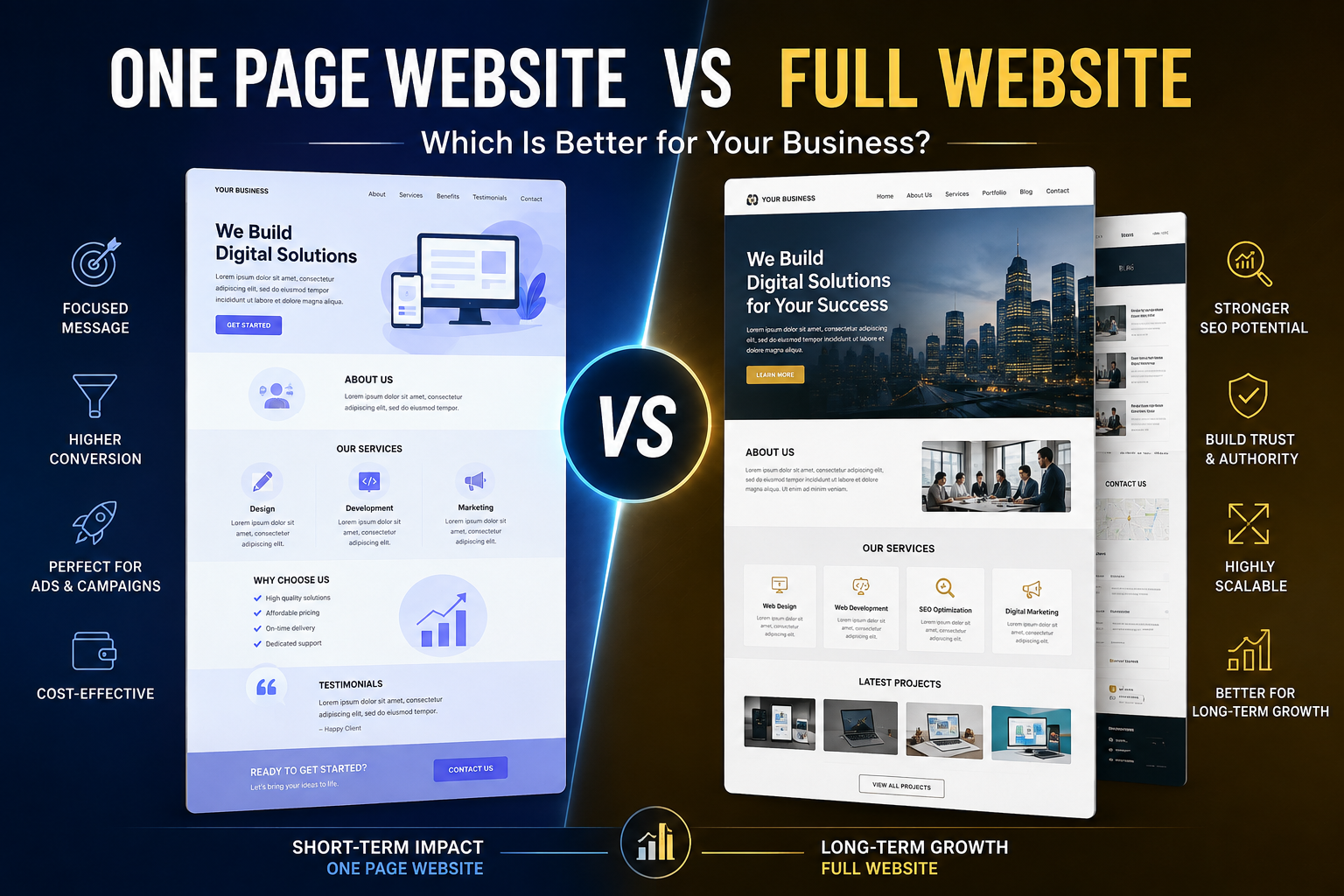
A Simple Way to Decide
If your website mainly needs:
One offer + one audience + one main action → A one-page website may be enough.
If your website needs:
Multiple services + different search topics + room to grow → A multi-page website will usually provide more flexibility.
Final Thoughts
There is no absolute winner between a one-page website and a full website.
The right structure depends on your business model, customer journey and long-term plans.
A one-page website can work very well when you have one clear offer, a focused audience and a simple conversion goal.
A multi-page website is usually more suitable when your business offers several services, needs detailed content or wants to build broader organic search visibility over time.
The most important thing is to choose a structure that supports both your current needs and how you expect the business to grow.
If you already have a website and are deciding whether to improve the current site or start again, our guide on whether to redesign your existing website or build a new one covers that decision separately.
Businesses planning a new website can also explore our website design and development services to understand how website structure, content and functionality can be planned around business goals.
Frequently Asked Questions (FAQs)
Can a one-page website rank on Google?
Yes. A one-page website can rank when it focuses on a clear topic and provides useful content. A multi-page website is usually better when you want to target several different services or search intents.
Which is better for a small business, a one-page or multi-page website?
It depends on the business. A one-page website can work well for a simple business with one main offer, while a multi-page website is usually more suitable for businesses with several services, products or growth plans.
What kind of businesses benefit from a one-page website?
One-page websites work well for freelancers, consultants, events, campaigns, personal portfolios and businesses promoting one main product or service. They are most effective when the message and conversion goal are simple.
Can I add more pages to a one-page website later?
Yes. A one-page website can be expanded into a multi-page website as the business grows. The amount of work required depends on how the original website was designed and how much the content needs to be reorganised.
How many pages should a small business website have?
Most small business websites have around 6 to 12 core pages, such as a home page, service pages, an About page and a Contact page. The exact number depends on the number of services, locations and information your customers need, and more pages can be added as the business grows.
Is a one-page website cheaper than a multi-page website?
Sometimes. A one-page website may require less content and development work, but the final cost still depends on the design, functionality and level of customisation.