Images make websites easier to understand, more visually engaging, and, in many cases, more persuasive. But there is one problem: the information contained inside an image may not always be as obvious to search engines and assistive technologies as it is to a human visitor.
This is where image alt text, or alternative text, becomes important.
Google recommends using descriptive alt text to help explain an image and its relationship with the surrounding page content. It also recommends placing relevant images close to related text so that Google has more contextual information about what the image represents.
For businesses working on website SEO optimization, alt text may appear to be a small technical detail. Across hundreds or thousands of website images, however, poorly implemented alt attributes can become a significant image SEO and accessibility issue.
What is Alt Text?
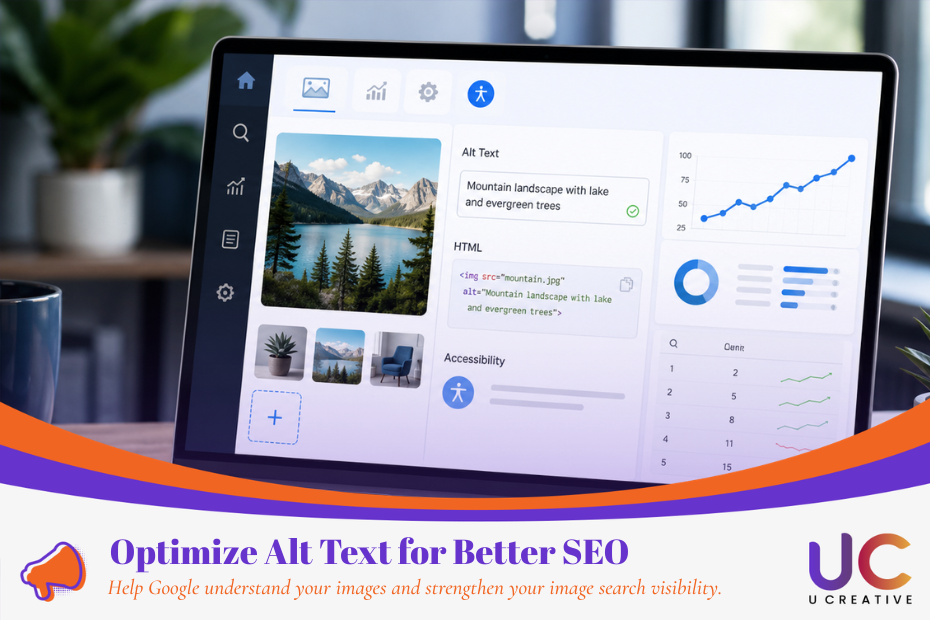
Alt text, short for alternative text, is text added to an image through the HTML alt attribute.
For example:
<img src="seo-dashboard.jpg" alt="SEO performance dashboard showing organic traffic growth">Its main purpose is to communicate the meaning or function of an image when the image itself cannot be perceived normally.
Alt text can be useful when:
- a screen reader needs to describe an image;
- an image fails to load;
- a search engine is determining what an image represents;
- an image functions as a link or button.
Google describes alt text as a short but descriptive explanation that helps its systems understand both the image and how it relates to the page.
Alt text therefore serves both accessibility and SEO, rather than being something that should be written purely for search engines.
Does Alt Text Help SEO?
Yes, but not in the way some SEO guides describe it.
Adding your target keyword to every image does not automatically improve your Google ranking.
Instead, properly written alt text gives Google another contextual signal about the image and the topic of the page. Google specifically recommends creating useful, information-rich alt text and using keywords where they naturally make sense while avoiding keyword stuffing.
There are several SEO benefits.
1. Helps Google Understand Your Images
A filename such as:
IMG_98372.jpgprovides very little useful information.
An appropriate alt attribute such as:
alt="technical SEO audit showing broken internal links"provides considerably more context.
Google can combine this information with the image filename, surrounding copy, and overall page topic to understand the image more accurately.
2. Improves Google Images SEO
Image search can become another discovery channel for your website.
Consider an ecommerce website selling office furniture.
Instead of:
alt="chair"a better description might be:
alt="black ergonomic office chair with adjustable headrest"The second version explains exactly what is shown and can help Google associate the image with relevant searches.
This is especially valuable for industries where customers frequently search visually, including ecommerce, food, interior design, fashion, travel, real estate, and professional portfolios.
3. Strengthens Page Context
Alt text should support the subject of the page rather than exist as an isolated keyword field.
Imagine an article discussing a technical SEO audit with a screenshot showing crawling errors.
A useful alt text could be:
alt="technical SEO audit report showing website crawling errors"It reinforces the relationship between the screenshot and the surrounding discussion without unnecessarily repeating keywords.
4. Makes Images More Accessible
SEO should not come at the expense of accessibility.
People using screen readers rely on text alternatives to understand important information communicated through images.
W3C recommends different approaches depending on the purpose of an image. Informative images normally require a useful text alternative, while decorative images can use an empty alt attribute such as alt=””.
This distinction is important because not every image needs a keyword-rich description.
5. Alt Text Can Matter When an Image Is a Link
There is another SEO scenario that is frequently overlooked.
When an image itself functions as a link, Google can use the image’s alt text similarly to anchor text to understand where that link leads.
For example:
<a href="/technical-seo-services/">
<img src="seo-audit.jpg" alt="Technical SEO audit services">
</a>
In this situation, meaningful alt text becomes particularly important.
How to Write SEO-Friendly Alt Text?
Effective alt text SEO comes down to relevance rather than keyword density.
1. Describe What Actually Matters
Your alt text should allow someone who cannot see the image to understand why the image appears on the page.
Instead of:
alt="SEO"use:
alt="Google Search Console report showing increasing organic clicks"The second example communicates actual information.
2. Include Keywords Naturally
There is nothing wrong with placing an SEO keyword in alt text when the keyword genuinely describes the image.
For example, on a page about SEO services:
Good:
alt="SEO specialist conducting a technical website audit"Bad:
alt="SEO Malaysia SEO agency Malaysia best SEO services Malaysia cheap SEO company"The second example is keyword stuffing.
Google explicitly advises against filling alt attributes with keywords because it creates a poor user experience and may appear spammy.
3. Match the Page Context
The same image could reasonably have different alt text depending on why it is used.
Imagine a screenshot of Google Search Console.
On an article about indexing:
alt="Google Search Console page indexing report"On an article about organic traffic:
alt="Google Search Console report showing organic search clicks"Alt text should communicate the purpose of the image within the current page, not simply catalog every object visible in it.
4. Keep It Concise
There is no SEO benefit in turning an alt attribute into a paragraph.
W3C recommends making text alternatives as concise as possible while still communicating the purpose of the image. If substantial explanation is necessary, such as with complex charts or diagrams, that information is usually better provided elsewhere on the page.
5. Avoid Meaningless Descriptions
Avoid alt text such as:
- image
- photo
- picture
- banner
- image01
- product image
- click here
These descriptions provide little additional context. Instead, explain what the image contributes to the page.
Should Every Image Have Alt Text?
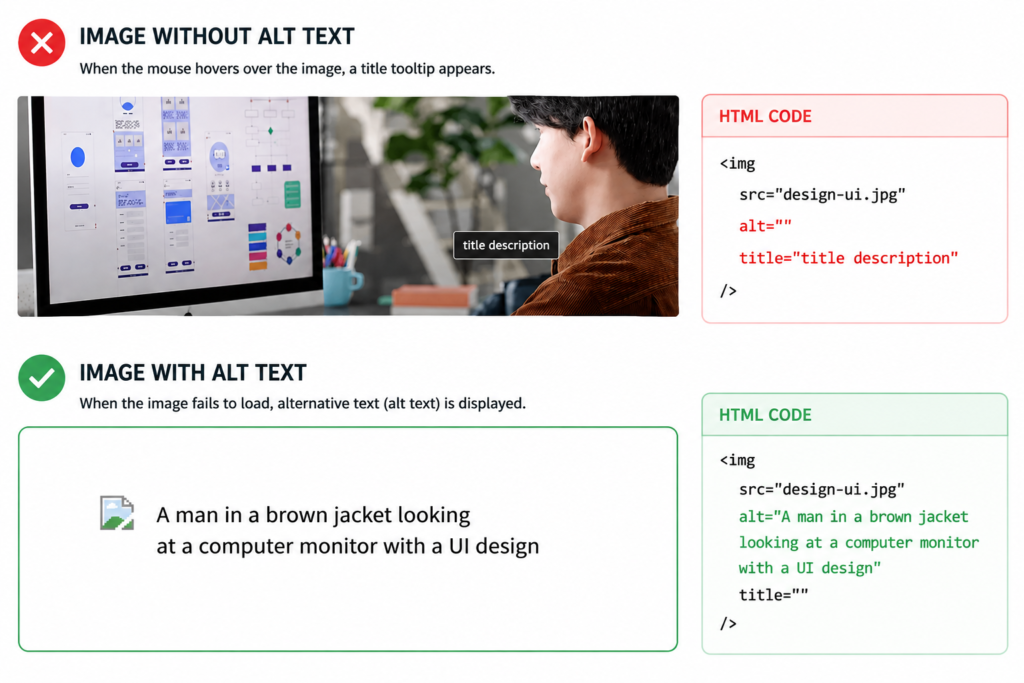
Every HTML image should be handled appropriately, but that does not mean every image needs descriptive text.
Informative images generally need meaningful text alternatives.
Decorative images should generally use an empty attribute:
alt=""This is different from completely omitting the alt attribute and helps assistive technologies identify that the image does not contain important information.
This is one reason automated SEO tools showing hundreds of “empty alt attributes” should not automatically be treated as proof of an SEO problem.
You need to understand the purpose of each image first.
How to Audit Image Alt Text for SEO?
For a small website, checking images manually may be manageable.
For an e-commerce or corporate website containing hundreds or thousands of images, alt text should become part of a broader technical SEO audit.
An image SEO audit should review:
- Images completely missing alt attributes
- Informative images with empty alt text
- Decorative images containing unnecessary descriptions
- Repeated alt text across many images
- Keyword-stuffed alt attributes
- Generic descriptions such as “image01”
- Product images with insufficient descriptions
- Linked images without meaningful alternatives
- Poor image filenames
- Large or unoptimized image files affecting page performance
This is where professional image SEO optimization services go beyond simply adding keywords to WordPress Media Library fields.
The objective should be to improve the entire relationship between images, page content, accessibility, crawling and user experience.
Final Thoughts: Is Alt Text Important for SEO?
Yes.
But the value of alt text comes from making an image easier to understand, not from providing another location to insert keywords.
Good alt text should satisfy three questions:
- What does this image communicate?
- Why is this image relevant to the page?
- Would this description still be useful if someone could not see the image?
If the answer is yes, you are probably on the right track.
For businesses investing in SEO services in Malaysia, image optimization should form part of a wider technical SEO strategy covering crawling, indexing, content structure, internal linking, page speed and search intent.
A proper technical SEO audit can identify these issues across an entire website rather than optimizing individual images in isolation.
FAQ
What is alt text in SEO?
Alt text is an HTML attribute used to communicate the meaning or function of an image. It can help search engines understand the image’s relationship with surrounding page content while also improving accessibility.
Does alt text improve Google rankings?
Not really. Alt text can provide Google with additional information about an image and page context, particularly for image search. However, adding keywords to alt attributes does not guarantee higher rankings. Google recommends useful, descriptive alt text rather than keyword stuffing.
Should I put SEO keywords in image alt text?
Yes, when the keyword genuinely describes the image. Do not modify an accurate image description solely to insert a target keyword.
How long should alt text be?
There is no universal SEO character limit that every alt attribute must follow. The description should be concise while communicating the essential meaning or purpose of the image. Complex information should generally be explained in the surrounding page content rather than placed entirely inside the alt attribute.