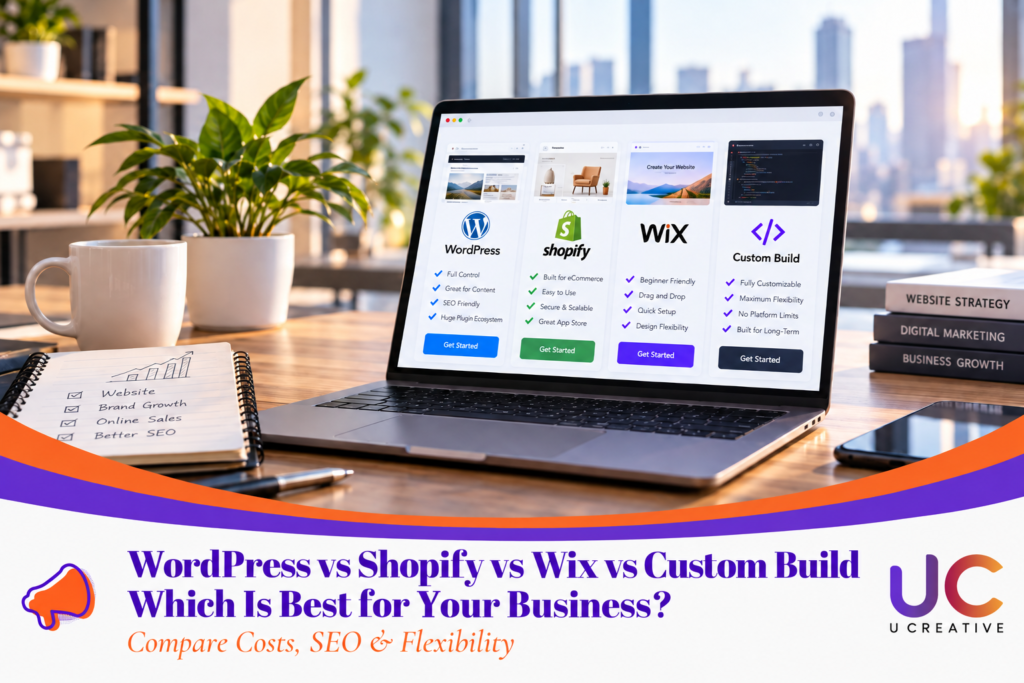
Choosing the right website platform affects how your business manages content, attracts customers, sells products and grows over time.
WordPress, Shopify, Wix and custom-built websites offer different advantages. For Malaysian businesses, the best choice depends on your budget, business goals and long-term requirements.
Quick Answer: Which Website Platform Is Right for You
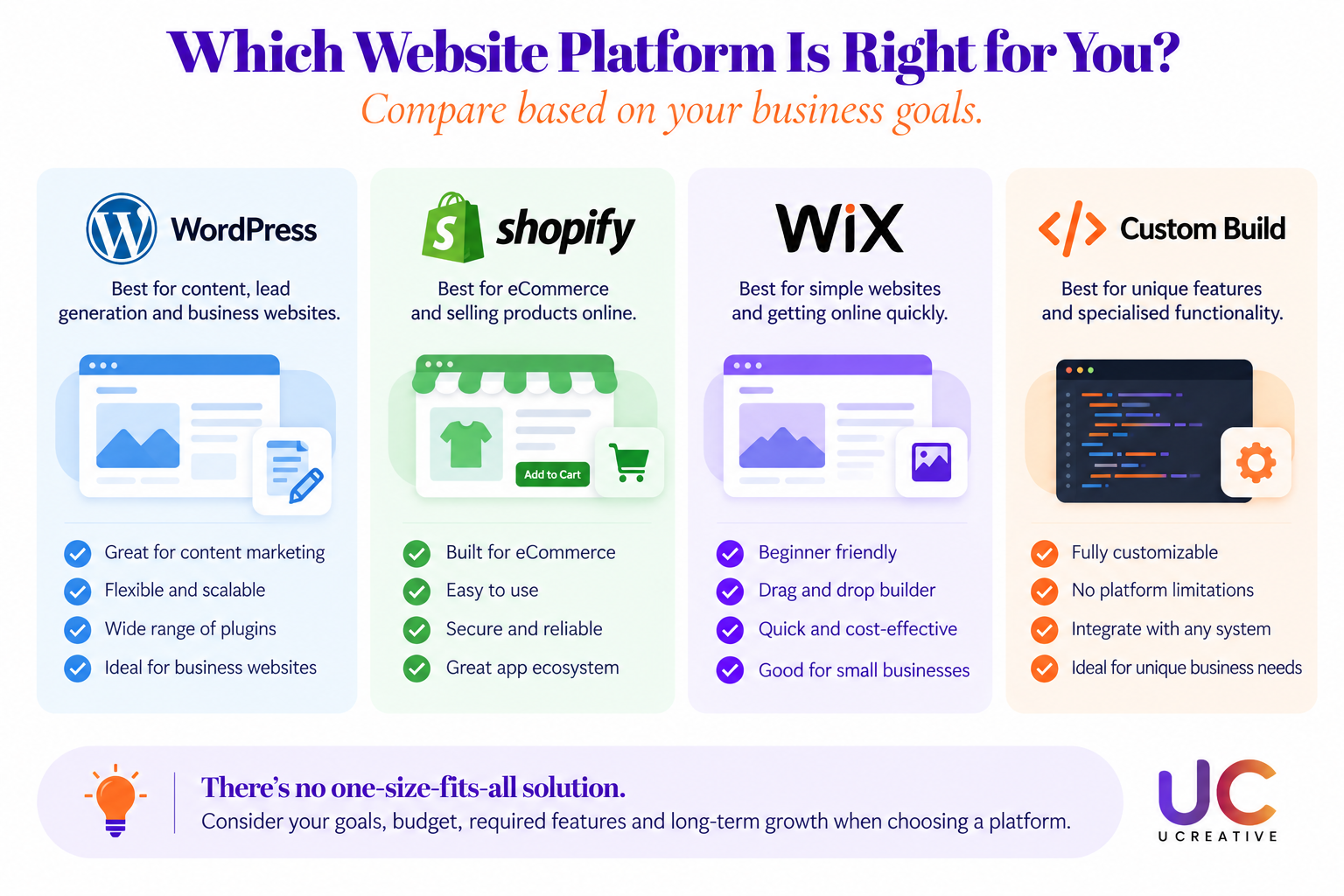
WordPress is a flexible choice for content-driven business websites and SEO, Shopify is built for online selling, and Wix suits simpler websites that are easy to manage. Custom development is worth considering when your business needs specialised features or system integrations.
| Platform | Best for | Main trade-off |
|---|---|---|
| WordPress | Service businesses, corporate websites and content marketing | Requires ongoing maintenance |
| Shopify | E-commerce businesses | Subscription and app costs |
| Wix | Small businesses and simple websites | Customisation and migration limits |
| Custom Build | Complex business systems and requirements | Higher development and maintenance responsibility |
There is no universal winner. The right platform should support your current needs without unnecessarily limiting future growth.
WordPress vs Shopify vs Wix vs Custom: What's the Difference?
WordPress: Flexible for Business Websites and SEO
WordPress is an open-source content management system (CMS) that allows businesses to manage website pages, articles and other content.
It is suitable for companies that regularly publish service pages, product information, articles or case studies. It can also support e-commerce through WooCommerce.
Its main advantage is flexibility, although hosting, plugin updates, security and ongoing maintenance require attention.
Shopify: Built for E-Commerce
Shopify is a hosted e-commerce platform designed for managing products, orders, payments and inventory.
It is a practical choice for retailers that want established online selling tools without maintaining their own hosting infrastructure.
However, businesses should consider subscription fees, paid apps, payment processing costs and platform-specific customisation limits.
Wix: Simple to Set Up and Manage
Wix is a hosted website builder with visual editing tools that allow businesses to create and update websites without extensive technical knowledge.
It works well for straightforward company websites, portfolios and service information.
However, businesses with complex functionality or future migration plans should assess its customisation and platform portability limitations.
Custom Build: Designed for Specific Business Requirements
Custom website development uses a tailored technical architecture to support specialised functionality or business workflows.
It can be suitable for companies that require customer portals, approval systems, customer-specific pricing or integration with internal software.
Custom development provides flexibility but typically requires more development resources and technical maintenance. It does not automatically guarantee better performance or SEO.
Which Platform Is Better for SEO?
All 4 platforms can support search engine optimisation. The main difference is how much technical control they provide and how easily SEO changes can be implemented.
| SEO factor | WordPress | Shopify | Wix | Custom Build |
|---|---|---|---|---|
| Meta titles and descriptions | Supported | Supported | Supported | Must be implemented |
| Blogging | Strong CMS features | Supported | Supported | Depends on implementation |
| URL flexibility | High | Some constraints | Platform-dependent | Developer-controlled |
| Structured data | Plugins or custom code | Themes, apps or code | Built-in and custom options | Must be implemented |
| Technical customisation | High | Platform-dependent | Platform-dependent | Potentially extensive |
WordPress offers flexibility for businesses that regularly publish SEO content, while Shopify provides features suited to e-commerce SEO. Wix can support search optimisation for less complex websites.
Custom development offers extensive technical flexibility, but SEO foundations must be implemented correctly.
The platform alone does not determine Google rankings. Website structure, content quality, crawlability, performance and competition also matter.
How Much Do WordPress, Shopify, Wix and Custom Websites Cost?
Website costs depend on the platform, required functionality and whether you build the website yourself or hire a professional developer.
| Platform | Basic platform or hosting cost | Professional development | Additional costs |
|---|---|---|---|
| WordPress | Free core software; entry-level hosting often around RM15–RM80/month | Project-based | Domain, premium plugins, maintenance |
| Shopify | Basic plan advertised from US$29/month with annual billing on its general pricing page | Optional, project-based | Apps, payment processing and transaction-related fees |
| Wix | Free option available; business websites generally require a paid plan | Optional, project-based | Premium apps, domain and plan upgrades |
| Custom Build | Depends on hosting and infrastructure | Quoted based on project scope | Developer support, security and integrations |
Prices are indicative and may vary by provider, location, billing cycle and project requirements. They are not U Creative quotations. Confirm current Shopify and Wix pricing before purchasing.
Look Beyond the Initial Price
Instead of choosing based on the lowest starting price, consider the total cost of ownership over three years.
3-Year Total Cost = Initial Development + Hosting or Subscriptions + Maintenance + Paid Extensions + Future Enhancements
For example, Shopify may involve additional app and payment processing fees, while WordPress requires budgeting for hosting, plugins and maintenance. Custom development may have higher upfront costs, particularly when specialised features or integrations are needed.
The best choice depends on both your initial budget and long-term maintenance needs.
If you’re comparing professional quotations, understanding website design costs and quotation differences can help you evaluate what’s included beyond the initial price.
What Matters Most for Malaysian Businesses?
Beyond platform features and pricing, consider how your website will support daily operations.
Local Payments and E-Commerce Integrations
Businesses selling online should check support for payment methods commonly used in Malaysia, including FPX, DuitNow, cards and relevant e-wallets.
If you sell across multiple channels, consider whether the platform can integrate with Shopee, Lazada, TikTok Shop and your inventory systems.
Integration availability depends on the platform, payment provider and business requirements.
Multilingual Content and SEO
Businesses serving different audiences may need English, Bahasa Malaysia and Chinese content.
Consider how easily the platform manages translated pages, navigation, metadata, language-specific URLs and ongoing updates.
Ownership and Future Migration
Before committing to a platform, understand what happens if you change developers or website providers.
WordPress websites can generally move between compatible hosting providers. Shopify and Wix offer data export options, but migrating layouts or platform-specific functionality may require rebuilding.
For custom websites, clarify code ownership, documentation and access to development resources.
A useful question is: If we change platforms in 3 years, what can we take with us, and what needs to be rebuilt?
Which Platform Fits Your Type of Business?
The best platform depends on what your website needs to achieve.
| Business type | Platform worth considering | Main reason |
|---|---|---|
| Service provider or consultant | WordPress or Wix | Service information and enquiries |
| Manufacturer or B2B supplier | WordPress or Custom Build | Product catalogues and potential integrations |
| Online retail business | Shopify or WooCommerce | Product and order management |
| Freelancer or small startup | Wix or WordPress | Straightforward content management |
| Business with complex internal systems | Custom Build or an extended existing platform | Specialised functionality |
For example, a manufacturing company that needs a product catalogue, downloadable brochures and quotation forms may find WordPress sufficient.
However, if the same company requires distributor accounts, customer-specific pricing or real-time ERP integration, a more customised solution may be appropriate.
Similarly, Shopify may suit retailers looking for established commerce tools, while WooCommerce can be practical for businesses already using WordPress.
Choose the platform based on your business requirements, not simply its popularity.
So, Which Website Platform Should You Choose?
The best website platform depends on your business goals, budget and future requirements. Whether you choose WordPress, Shopify, Wix or custom development, focus on a solution that supports your operations and long-term growth.
Frequently Asked Questions (FAQs)
Which website platform is best for small businesses in Malaysia?
WordPress is a flexible option for businesses focused on services, content and SEO. Wix suits simpler websites with minimal technical requirements, while Shopify is better suited to online stores. The best choice depends on your budget, business goals and required features.
Is WordPress or Shopify better for an online store?
Shopify offers built-in e-commerce tools and managed hosting, making it convenient for online retailers. WordPress with WooCommerce provides greater control over hosting and customisation but requires more technical maintenance.
Which website platform is best for SEO?
WordPress, Shopify, Wix and custom-built websites can all perform well in search engines. WordPress offers extensive content management flexibility, while Shopify provides e-commerce SEO features. Rankings depend more on SEO implementation, website quality and competition than the platform itself.
Which is cheaper: WordPress, Shopify or Wix?
Wix can be affordable for simple websites, while WordPress offers free core software but requires hosting and maintenance. Shopify has recurring subscription fees. The cheapest option depends on your required features, paid extensions and long-term costs.
When should a business choose custom website development?
Custom development is worth considering when standard platforms cannot adequately support specialised workflows, customer portals, complex integrations or unique business requirements. It is not always necessary for a typical corporate website or online store.
Can I switch website platforms as my business grows?
Yes, but migrating between platforms may require rebuilding layouts, transferring content and replacing integrations. A proper SEO migration plan is also important to preserve URLs, redirects and search visibility.
Need Help Choosing the Right Website Platform?
Not sure which platform fits your business? U Creative can help you choose and build a website that supports your goals, budget and future growth. Explore our website design and development services and turn your website plans into action.
Discuss Your Project