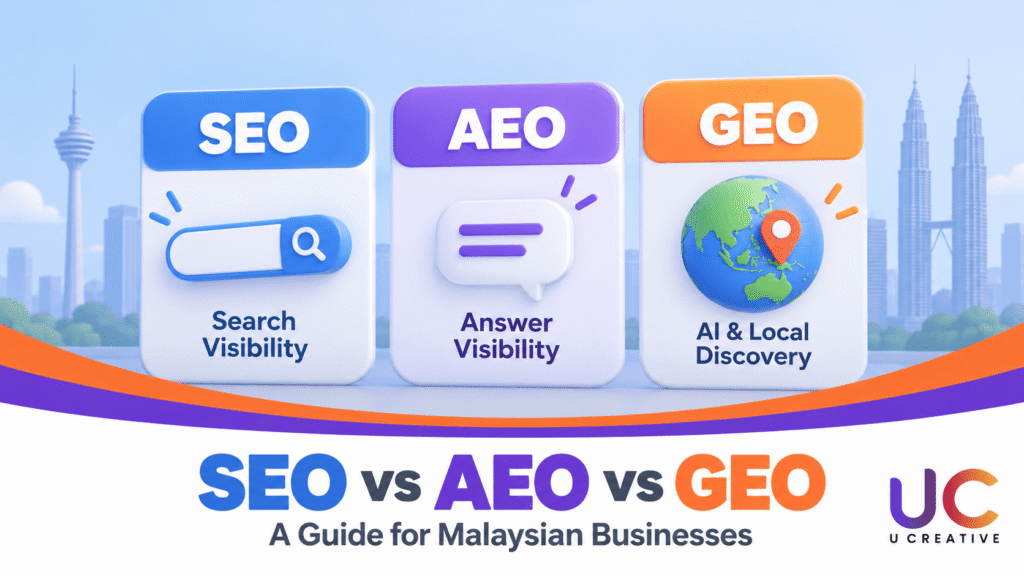
SEO, AEO and GEO are complementary approaches to online visibility. SEO helps webpages appear in traditional search results. AEO makes information easier to use in direct answers. GEO improves how clearly generative AI systems can understand, reference and represent a brand or its content.
They are not three completely separate marketing channels, and businesses do not need to choose only one. Strong SEO normally provides the technical and content foundation, while AEO and GEO expand how that information can be discovered when users receive direct or AI-generated answers.
This guide explains how the three approaches differ, what they can realistically achieve and which areas Malaysian businesses should prioritise.
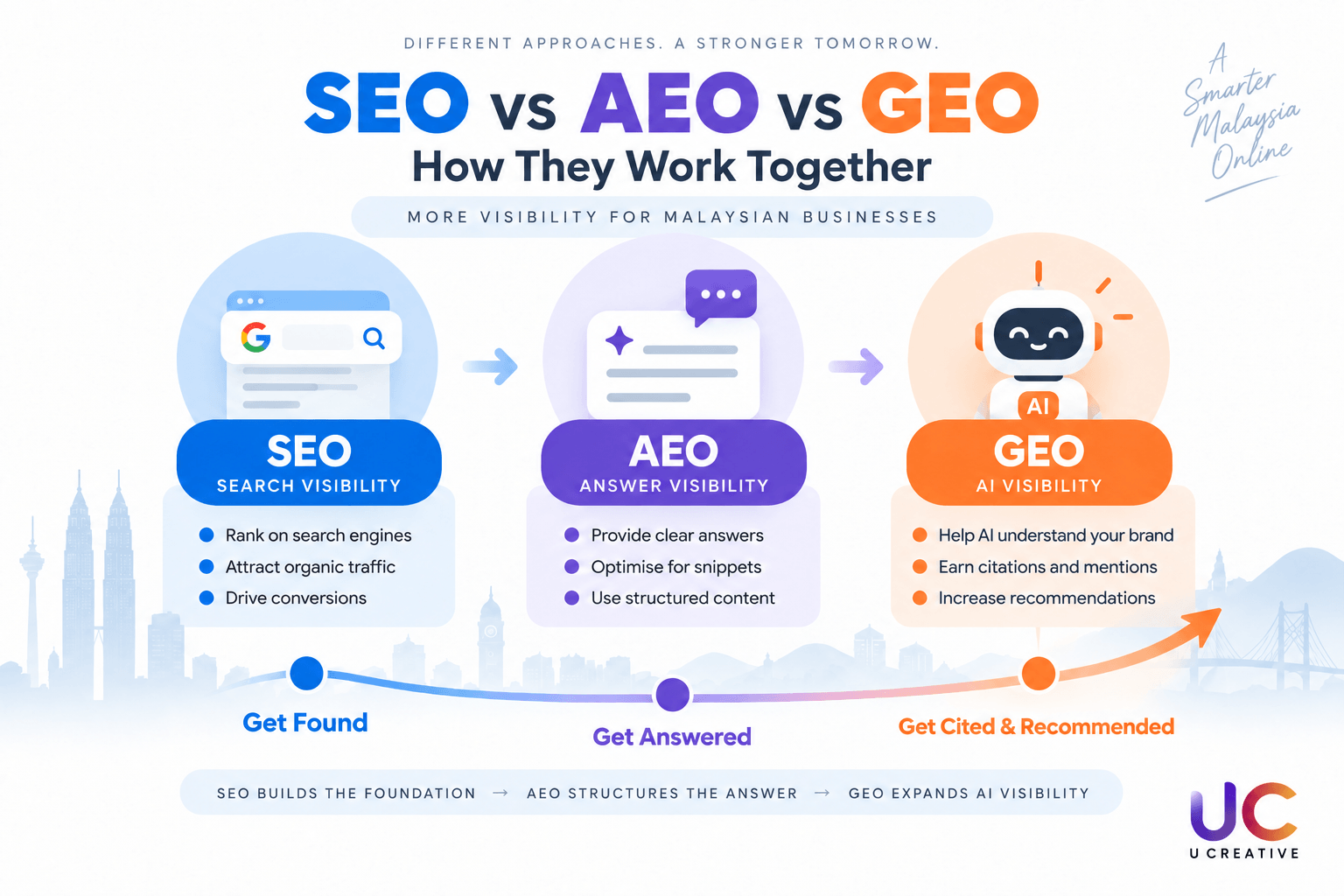
SEO vs AEO vs GEO at a Glance
| Area | SEO | AEO | GEO |
|---|---|---|---|
| Full name | Search Engine Optimisation | Answer Engine Optimisation | Generative Engine Optimisation |
| Main purpose | Improve visibility in search results | Make content easier to extract as a direct answer | Improve brand and content visibility in generative AI responses |
| Common surfaces | Google and Bing search results | Featured snippets, answer boxes and conversational answers | Google AI Overviews, AI Mode, ChatGPT, Gemini and other generative platforms |
| Main focus | Crawling, indexing, relevance, content, links and user experience | Clear answers, question coverage and structured information | Entity clarity, credible information, topic authority and supporting mentions |
| Possible outcome | Rankings, organic traffic and conversions | Direct-answer visibility and assisted discovery | Brand mentions, citations and recommendation visibility |
These terms overlap, and the industry does not use every label in exactly the same way. What matters is not the terminology itself, but whether customers and search systems can find, understand and trust the information about your business.
What Is SEO?
SEO is the process of improving a website so search engines can crawl, understand and rank its pages for relevant searches.
Its main components include technical SEO, search intent research, website structure, helpful content, internal linking, relevant backlinks, local SEO and conversion measurement.
For example, a Penang manufacturer may use SEO to improve visibility for searches such as “precision machining supplier Malaysia” or “OEM metal parts manufacturer Penang”.
SEO is not only about rankings. The target page must also answer the user’s needs and guide qualified visitors towards an enquiry, quotation or purchase.
What Is AEO?
AEO focuses on making information clear enough to answer a user’s question directly.
This may involve:
- Answering important questions near the beginning of a section
- Using descriptive headings
- Explaining technical terms in plain language
- Creating useful comparison tables
- Covering relevant follow-up questions
- Organising information into logical steps
- Adding structured data when it accurately represents visible content
Suppose a customer asks:
How long does precision machining take in Malaysia?
An AEO-friendly page would provide a concise answer first, followed by the factors that affect lead time, such as material, tolerances, order quantity and finishing requirements.
AEO does not mean every paragraph should be reduced to a short answer. The direct response helps users understand the key point, while the supporting explanation provides the context needed to make a decision.
What Is GEO?
GEO focuses on improving how a brand, organisation or piece of content is understood and represented by generative AI systems.
Useful GEO work includes clear company and service information, consistent brand details, strong topic coverage, original evidence, visible credentials, relevant case studies and credible third-party mentions.
GEO therefore builds on many of the same foundations as good SEO. It places additional attention on entity clarity, evidence, reputation and the wider sources that help an AI system understand a brand. For a deeper implementation guide, see how to optimise for Google AI Overviews and AI search.
Recognition, Citation and Recommendation Are Different
A practical way to evaluate AI visibility is to separate it into three levels.
1. Recognition
The AI system can identify the business and accurately explain:
- Its name
- Location
- Services or products
- Target customers
- Areas of expertise
2. Citation
The system uses the business website or its content as a supporting source and provides a visible citation or link.
3. Recommendation
The system includes the business in an answer even when the user has not mentioned the brand, such as when asking for suitable providers, products or solutions.
A business may be recognised correctly without being cited or recommended. Clear website information can support recognition, but broader recommendation visibility may also depend on relevance, reputation, reliable third-party information and the sources available to each platform.
This is why a single screenshot of an AI mentioning a brand is not enough to prove complete GEO success.
One Search Journey, Three Strategies
Consider a fictional precision-parts manufacturer in Penang called ABC Precision.
A purchasing manager could search or ask:
Which precision machining supplier in Malaysia is suitable for low-volume industrial parts?
How SEO Helps
SEO gives ABC Precision a relevant, indexable service page explaining its machining capabilities, materials, tolerances, industries and service locations.
How AEO Helps
AEO ensures the page clearly answers questions such as:
- Does the company accept low-volume orders?
- What materials can it machine?
- What tolerances are available?
- How long does production take?
- Does it serve customers outside Penang?
How GEO Helps
GEO strengthens the information that helps AI systems understand whether ABC Precision is a credible match. This may include consistent company information, detailed capabilities, real project evidence, certifications, customer reviews and relevant third-party mentions.
All three approaches support the same customer journey at different stages.
Does GEO Replace Traditional SEO?
No. GEO does not replace SEO.
For Google AI features, a page must still be crawlable, indexed and eligible to appear in Search with a snippet. Google also says there is no special schema or machine-readable AI file required to appear in AI Overviews or AI Mode.
If a website has major technical problems, unclear service pages or weak content, adding a few FAQs and calling it GEO will not solve the underlying issue.
Businesses should normally address the foundation in this order:
- Ensure important pages can be crawled and indexed.
- Match each page to a clear customer need or search intent.
- Provide complete, accurate and useful information.
- Strengthen internal links and site structure.
- Add credible evidence, authorship and business details.
- Build relevant authority and third-party recognition.
- Monitor visibility, traffic and business outcomes.
If your pages are missing from Google, start by understanding why a page may be crawled but not indexed before investing heavily in AI-specific positioning.
Which Strategy Should Your Business Prioritise?
Most businesses should start with SEO before investing heavily in AEO or GEO. Use the table below to identify your current priority.
| Your Current Situation | What to Prioritise |
|---|---|
| Important pages are not appearing on Google | Technical SEO and content quality |
| Your website receives little relevant traffic | SEO, search intent and useful content |
| Your content is detailed but difficult to understand | AEO and clearer answer structure |
| AI tools provide unclear information about your business | Consistent company information and stronger GEO signals |
| Your brand is rarely mentioned or cited | Original content, case studies, reviews and third-party mentions |
SEO builds the foundation. AEO makes information easier to use in direct answers, while GEO helps AI platforms understand and reference the business.
Building the Right Foundation
Improving AI visibility involves more than adding FAQs or rewriting a few paragraphs. A website must be crawlable, clearly explain its services and support important claims with reliable information.
U Creative combines SEO services with website design and development to address technical issues, strengthen content and build a clearer foundation for visibility across traditional and AI-powered search.
The goal is not simply to appear in an AI-generated answer. It is to make your business easier to find, understand and trust across both traditional and AI-powered search.
How to Measure SEO, AEO and GEO
| Area | What to Track |
|---|---|
| SEO | Rankings, organic traffic and conversions |
| AEO | Featured answers and question-based visibility |
| GEO | Brand mentions, citations and recommendation visibility |
| Business results | Enquiries, calls, WhatsApp clicks and sales |
Google Search Central confirms that traffic from AI Overviews and AI Mode is included under the Web search type in Search Console rather than reported separately. Businesses should therefore review Search Console together with analytics and conversion data.
For ChatGPT, Gemini and other AI platforms, test a consistent set of relevant questions and record whether the brand appears, how it is described and which sources are cited. Results can change, so one screenshot should not be treated as a permanent AI ranking.
Frequently Asked Questions (FAQs)
What Is the Difference Between AEO and GEO?
AEO focuses on making content easier to use in direct answers. GEO focuses on helping generative AI platforms understand, mention and cite a brand or its content. In practice, both rely on clear, useful and well-structured information.
Do Businesses Need SEO, AEO and GEO?
Most businesses need a combination of all three, but SEO should usually come first. SEO builds the technical and content foundation, while AEO and GEO extend visibility into direct answers and AI-generated responses.
Does Schema Markup Guarantee AI Visibility?
No. Schema markup can help search engines understand page content, but it does not guarantee an AI mention, citation or recommendation. The structured data should also match the information visible on the page.
Can a Small Business Benefit From GEO?
There is no fixed timeline. Results depend on crawling, indexing, content quality, brand authority, third-party mentions and how each AI platform retrieves information. GEO progress should be measured over time rather than through a single test.
How Long Does GEO Take to Work?
There is no fixed timeline. Changes depend on crawling, indexing, source availability, brand authority and how frequently each AI platform updates or retrieves information. No agency can guarantee when a particular platform will mention or cite a brand.
Build Visibility Across Search and AI Answers
SEO, AEO and GEO work best as one connected strategy. UCreative helps Malaysian businesses improve technical SEO, website structure, content and AI search readiness based on their existing visibility and goals.
Discuss Your Search Visibility Goals