
Yes, SEO services can still be worth investing in when customers search for what you offer, your website can turn visitors into enquiries, and the potential business value justifies the cost.
They may not be the right immediate priority if you need sales within weeks, have little relevant search demand, or cannot measure enquiries and conversions.
For Malaysian businesses, the decision should come down to three things: whether search can reach suitable customers, what those customers are worth, and whether professional help will improve results or save time.
When Are SEO Services Worth Investing In?
Customers Search for Services You Can Deliver
Look for searches connected to a real buying need, such as finding a supplier, comparing a service or checking whether a product solves a problem.
A Penang engineering company, for example, might benefit from searches for specific machining capabilities. A local service provider may need visibility within its service area rather than across Malaysia.
High search volume is not essential. What matters is whether the people searching could realistically become customers.
Your Website Helps Visitors Make a Decision
Relevant visitors need clear service information, evidence of your capabilities and an easy way to contact you.
If these are missing, the SEO plan should address them. Increasing organic traffic without improving an unclear offer or difficult enquiry process may produce little business value.
You Need Expertise or Capacity You Do Not Have Internally
Paying for SEO services makes more sense when the provider can handle work your team cannot complete effectively, such as technical SEO, search intent research, content optimisation or ongoing performance monitoring.
You do not always need an agency retainer. Smaller businesses may be able to handle some basic SEO work internally, depending on their time, skills and website complexity.
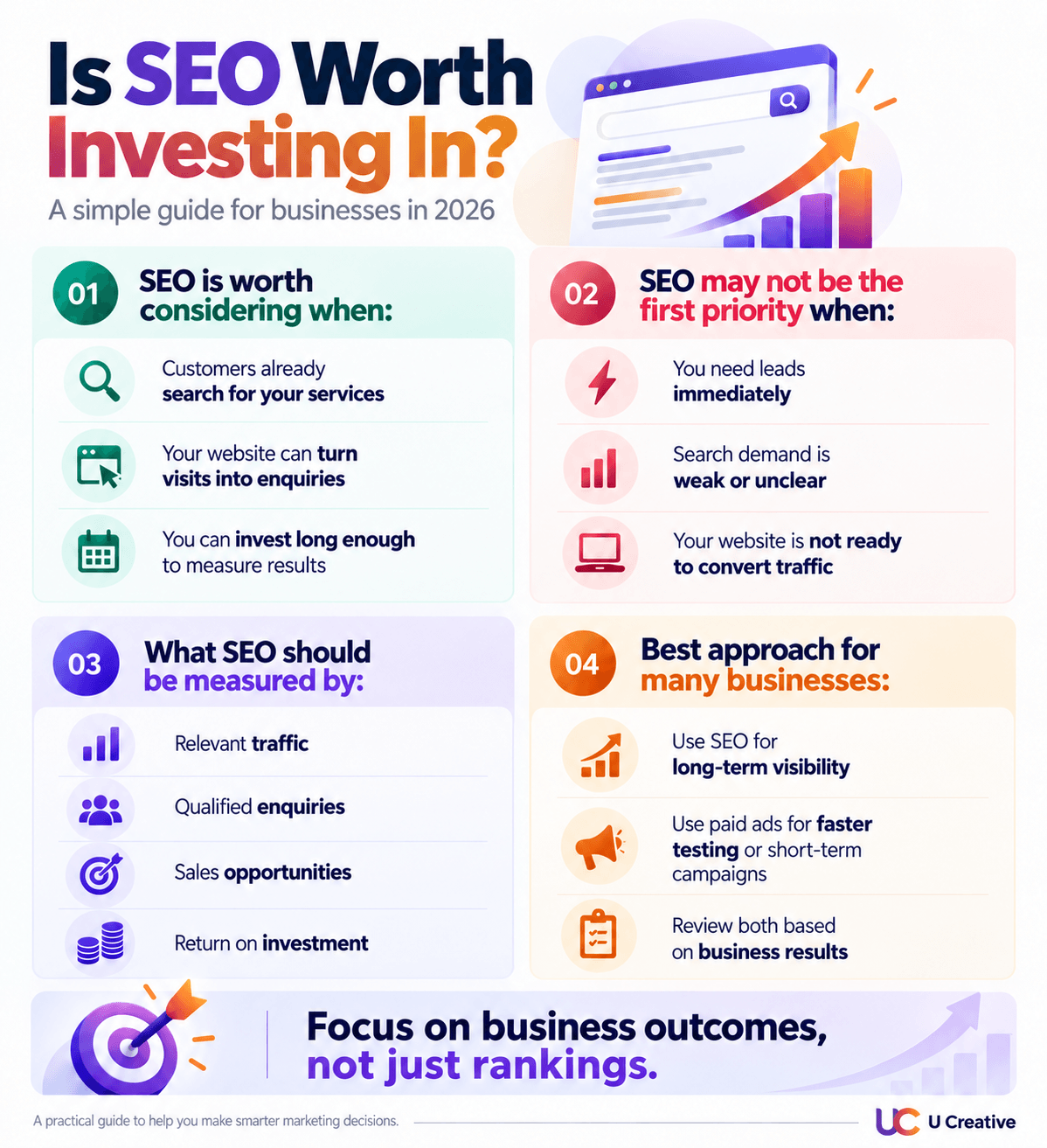
When Should SEO Not Be Your First Priority?
| Situation | A practical first step |
|---|---|
| You need enquiries immediately | Evaluate paid campaigns or direct sales activity |
| Your offer has not been validated | Test demand, messaging and pricing |
| Customers do not recognise the product category | Build awareness before relying on search demand |
| Your website has major usability problems | Fix essential content and enquiry paths alongside technical issues |
| You cannot connect enquiries to sales | Establish tracking and consistent sales records |
These conditions may change. The aim is to sequence the investment sensibly rather than commit to SEO simply because competitors are doing it.
How Many Customers Would You Need to Cover the Cost?
There is no universal SEO budget that suits every company. Compare the full cost with the contribution profit an additional customer brings.
Break-even customers = Total SEO investment ÷ Contribution profit per additional customer
Contribution profit is the amount left from each additional customer after the direct cost of delivering the product or service.
A Simple MYR Example
The figures below are hypothetical and are not a market price or forecast.
| Item | Example |
|---|---|
| Total SEO investment over six months | RM18,000 |
| Contribution profit per additional customer | RM3,000 |
| Additional customers needed to cover the investment | 6 |
RM18,000 ÷ RM3,000 = 6 additional customers.
This calculation gives the business a target to evaluate. It does not mean SEO will automatically generate six customers within six months.
The total investment should include relevant costs such as:
- Agency or consultant fees
- Content production
- Development work
- Internal staff time
Use profit rather than sales revenue, and avoid attributing every customer to SEO when paid advertising, referrals or other channels may also have contributed.
For businesses with repeat purchases, use a conservative customer-value estimate based on actual internal records.
SEO vs Paid Ads: Which Should You Invest in First?
Paid advertising offers faster control over when visibility begins. SEO involves developing organic search visibility over time. Neither guarantees profitable customers.
| Business need | Starting point to consider |
|---|---|
| Test a new offer quickly | A controlled paid advertising campaign |
| Promote a time-limited event or package | Paid ads with a focused landing page |
| Develop search coverage for established services | SEO |
| Reach customers now while developing organic visibility | A combination, if the budget supports both |
Google Ads can help test which search terms and messages generate useful enquiries. Those findings can inform SEO priorities, although paid results do not guarantee organic performance.
SEO does not charge a media fee for each organic click, but content, technical work and maintenance still cost money. Paid search also involves more than ad spend: management, creative work and landing pages may add to the total.
Compare channels using qualified customer acquisition cost and profit over a suitable period, rather than assuming organic traffic is always cheaper.
Has AI Search Made SEO Less Valuable?
AI search makes it important to separate being mentioned, receiving a visit and generating an enquiry.
An AI answer may provide information without a website visit. However, someone evaluating a supplier may still need to review capabilities, examples, terms or pricing before contacting the business.
According to Google Search Central’s guidance on AI features, existing SEO best practices remain relevant to AI Overviews and AI Mode. These features do not require special optimisation, and meeting the requirements does not guarantee inclusion.
Businesses should therefore prioritise accessible pages, accurate information and useful content supported by evidence. When evaluating services promising AI visibility, ask what work is included and how its value will be measured.
A Google ranking does not guarantee a recommendation in ChatGPT or another AI platform. Treat AI mentions as visibility indicators, rather than confirmed leads or revenue.
To understand how these approaches work together, read our guide to SEO vs AEO vs GEO.
How Long Does SEO Take to Show Results?
Google advises that benefits typically begin to appear four months to a year after changes are implemented. This is guidance, not a guaranteed deadline for rankings, leads or profitability.
Competition, your website’s starting position, implementation speed and customer sales cycle can all affect the timeline.
Agree on progress reviews with your SEO agency. Early reviews should explain what has been completed and whether relevant visibility is improving. Later reviews should assess whether that visibility is contributing to suitable enquiries and customers.
Allowing time for SEO should not mean accepting months of unexplained activity.
How Do You Measure Whether SEO Is Working?
Follow the journey from relevant searches to business outcomes.
| Stage | What to check |
|---|---|
| Visibility | Are useful pages appearing for searches related to your offer? |
| Visits | Is organic traffic reaching relevant service or product pages? |
| Enquiries | Are visitors submitting forms, calling or starting conversations? |
| Sales | Do those enquiries become suitable customers? |
| Return | Does their additional contribution profit justify the investment? |
Google Search Console can help assess search visibility and clicks. GA4 can record configured website actions, while sales records or a CRM can help establish lead quality and completed deals.
The exact business outcome will depend on how you make money. A local service business may focus on calls and appointments, a B2B company on quotation requests and won projects, and an e-commerce business on orders and customer value.
A WhatsApp button click does not confirm a conversation or a sale. Connect website activity with actual enquiries where possible.
Also check whether the ranking page matches the searcher’s needs. A service page may be appropriate for someone ready to enquire, while a comparison article may suit someone still evaluating options.
Review performance against a starting baseline and account for seasonality, paid campaigns and other marketing activity. Attribution has limits, so use consistent records rather than treating every organic visit as a sale created by SEO.
Final Thoughts
SEO services are worth considering when relevant demand, customer profit and your website’s readiness support the investment.
Choose a scope you can sustain, calculate what would cover the cost and track outcomes beyond rankings. That gives you a stronger basis for deciding whether to continue, adjust or redirect the budget.
Find Out Whether SEO Fits Your Business
As an SEO agency serving Kuala Lumpur, Selangor, Penang, Johor, and Kuching, we help businesses identify relevant search opportunities and plan improvements around their goals.
Start with a free SEO audit to understand your website’s current position and discuss where to focus your investment.
Get Your Free SEO AuditFrequently Asked Questions (FAQs)
It can be. SEO is more likely to create value when customers already search for the business’s services, the website can convert visitors and the investment matches the potential customer value.
Neither is always better. Google Ads can create visibility quickly, while SEO builds organic visibility over time. The right choice depends on budget, timing, search demand and customer acquisition costs.
Not always. Some businesses need an initial project and periodic support, while others benefit from ongoing technical work, content and optimisation. The provider should be able to explain why recurring work is necessary.
Not automatically. Ads may still support promotions or profitable searches. Review the customers and profit each channel contributes before reducing either budget.
No. An SEO agency can commit to agreed work, implementation and reporting, but cannot guarantee search positions, AI recommendations, customer behaviour or sales.
Review search relevance, the ranking pages, conversion tracking and the enquiry journey. Better rankings may be reaching the wrong audience or sending suitable visitors to pages that do not meet their needs.